
The ROI of expedited air freight isn’t about comparing shipping costs; it’s about preventing the catastrophic financial impact of a stockout or production line stoppage.
- The Total Cost of Stockout (TCOS)—including lost margin, penalties, and customer churn—often dwarfs the premium paid for air cargo.
- Hidden operational friction, such as customs delays and undeclared dangerous goods, can completely nullify the investment in speed if not managed proactively.
Recommendation: Shift from a cost-first to an ROI-first mindset by pre-calculating your TCOS for critical components and establishing a vetted emergency logistics protocol before a crisis hits.
For a supply chain manager, few scenarios are more stressful than watching a critical shipment fall behind schedule. A production line is about to go down, a key product launch is at risk, or a customer is facing a stockout. The immediate, high-cost solution is always there: expedited air cargo. The hesitation is understandable. The price tag is steep, and the decision feels more reactive than strategic. Conventional wisdom simply states that air freight is “faster but more expensive,” a platitude that offers little help when millions in revenue are on the line.
But this framing is fundamentally flawed. The decision to use expedited air cargo shouldn’t be a simple comparison between freight rates. It should be a rigorous, data-driven ROI analysis where the premium for speed is weighed against the full financial catastrophe of failure. The real metric isn’t the cost per kilogram; it’s the Total Cost of Stockout (TCOS). This includes direct lost margin, contractual penalties, damage to customer relationships, and internal disruption costs. When viewed through this lens, air freight transforms from a costly expense into a strategic risk mitigation instrument.
However, simply booking a flight is not enough. The value of speed is fragile. It can be instantly eroded by “operational friction”—the hidden delays in customs, packaging miscalculations, or compliance errors that can ground a shipment indefinitely. This analysis moves beyond the surface-level cost debate to provide a framework for not only justifying the use of expedited air cargo but also for protecting that investment by mastering the critical operational levers that ensure your shipment actually arrives on time.
To make an informed, defensible decision, it’s essential to understand the complete financial picture and the operational nuances that define success. This guide breaks down the key components of the air freight ROI equation, from initial cost-benefit analysis to final-mile visibility.
Contents: A Strategic ROI Analysis of Expedited Air Freight
- Why Air Freight Seems Expensive but Saves Money on Stockouts?
- How to Pre-Clear Air Cargo to Ensure Same-Day Release?
- Air Freight vs. Sea Freight Packaging: What Is the Weight Difference?
- The “Undeclared Battery” Mistake That Grounds Your Air Shipment
- Booking Air Charters: A Sequence to Secure Lift in Emergencies
- Spot Rates vs. Contract Rates: Which Strategy Protects Your Budget?
- Why Lead Times Vary Wildly Even on the Same Route?
- How to Maintain Visibility as Goods Move From Origin to Entry Terminals?
Why Air Freight Seems Expensive but Saves Money on Stockouts?
The sticker shock of an air freight quote often derails the conversation before it begins. However, this initial cost is only one side of the ROI equation. The other, more critical side is the Total Cost of Stockout (TCOS)—a figure that represents the full financial fallout of not delivering on time. When a production line stops or a retail shelf sits empty, the losses extend far beyond the margin on the undelivered goods. The true cost is a composite of direct and indirect damages.
Calculating your TCOS provides a powerful financial justification for using a premium service. It reframes the debate from “How much does this cost?” to “How much does this *save* us?”. The calculation involves quantifying four key areas: direct lost margin from unsold units, contractual penalties for late delivery, future revenue loss from customer churn, and internal disruption costs like overtime and rescheduling. Often, the TCOS from a single day of downtime can be an order of magnitude greater than the cost of an expedited shipment.
The increasing reliance on air cargo, evidenced by the 11.3% increase in global air cargo volumes in 2024, underscores its strategic value. As supply chains become leaner and more globalized, the financial risk of disruption grows. Smart supply chain managers are no longer viewing air freight as a last resort but as a calculated investment in business continuity. The analysis is shifting, with the narrowing gap between air and ocean freight costs making the decision to expedite more competitive than ever, especially when safeguarding against stockout risks during volatile peak seasons.
How to Pre-Clear Air Cargo to Ensure Same-Day Release?
Paying a premium for air freight is an investment in speed. One of the greatest threats to that investment is customs. A shipment can cross an ocean in 12 hours only to sit in a warehouse for 48 hours awaiting clearance. This “operational friction” negates the entire purpose of expediting. The single most effective tool to mitigate this risk is customs pre-clearance, also known as “Wheels Up” clearance.
This process involves submitting all required documentation and data to customs authorities at the destination country *while the aircraft is still in the air*. By the time the plane lands, customs has already reviewed the entry, and if all is in order, can grant immediate release. This allows cargo to be recovered and dispatched for final-mile delivery on the same day of arrival. The impact is significant, with proficient brokers demonstrating an up to 1 full day reduction in transit times through this process alone. This isn’t just a time-saver; it’s ROI protection.
Achieving successful pre-clearance requires flawless documentation and proactive coordination. It is not an automatic process. The importer of record, the shipper, and the customs broker must work in lockstep. This means providing a perfect commercial invoice, accurate Harmonized Tariff Schedule (HTS) codes, and precise values well before the flight departs. For companies that frequently expedite, creating a database of pre-vetted products with pre-assigned HTS codes is a best practice that dramatically accelerates the process.
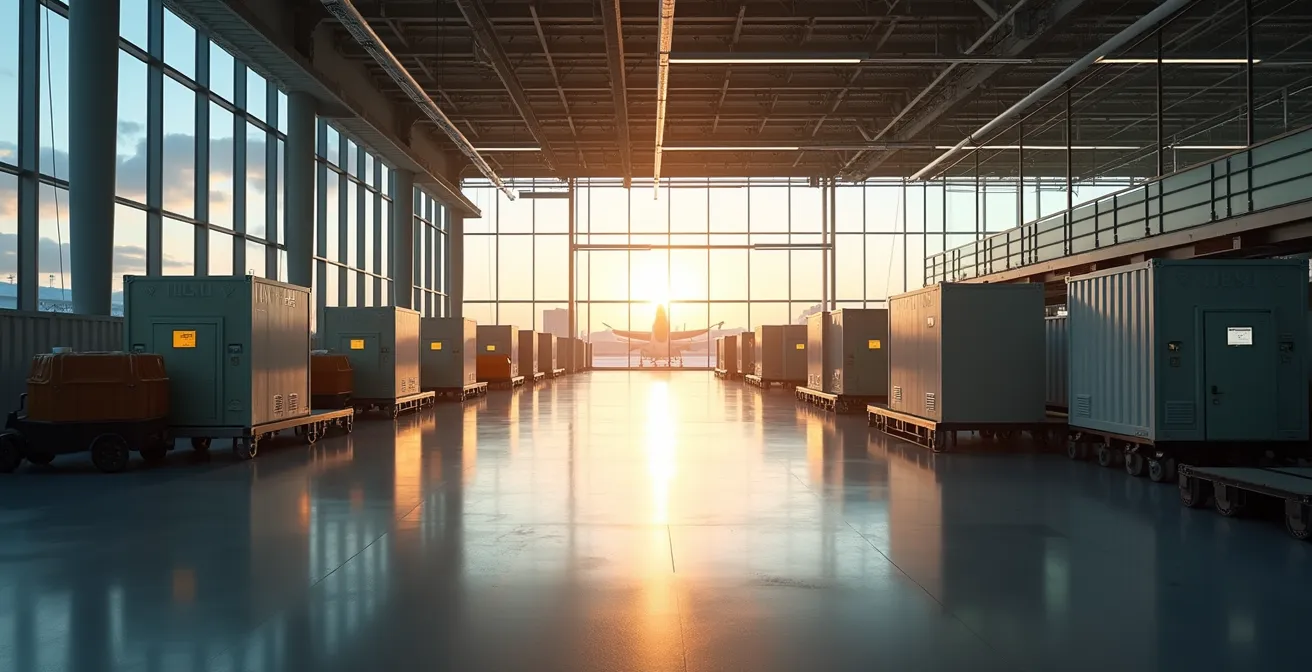
As the visual suggests, modern pre-clearance is a highly organized, technology-driven process. The goal is a seamless flow of data that precedes the physical flow of goods, eliminating costly dwell time at the destination terminal. Ultimately, mastering pre-clearance is non-negotiable for anyone serious about emergency logistics.
Your Pre-Clearance Audit Checklist: 5 Points to Verify
- Points of contact: Have you listed all customs brokers and internal stakeholders involved in the pre-clearance communication protocol for after-hours emergencies?
- Collecte: Do you have a complete inventory of required documents, including commercial invoices with HTS codes, values, and country of origin?
- Cohérence: Does your product database have pre-assigned and verified HTS codes for all critical parts to ensure declared values match invoices?
- Mémorabilité/émotion: Have you identified the most common documentation errors from past shipments to create a “never again” checklist for your team?
- Plan d’intégration: Is there a clear plan to submit data to your customs broker at least 2 hours before aircraft departure to enable wheels-up processing?
Air Freight vs. Sea Freight Packaging: What Is the Weight Difference?
When comparing air and sea freight, the cost analysis extends beyond the base rate to include chargeable weight, which is heavily influenced by packaging. This is a critical nuance that can make air freight more economically viable than it first appears. Sea freight, with its long transit times and harsh environmental exposure, demands heavy-duty, robust packaging—often thick wooden crating—to protect goods. This adds significant weight and volume.
In contrast, air freight’s shorter, smoother journey allows for much lighter packaging. Goods can often be shipped in reinforced cardboard or lightweight composite materials. This reduction in packaging weight directly translates to a lower chargeable weight, potentially leading to 10-15% savings on the total freight cost. Furthermore, air freight’s pricing model is sensitive to dimensional weight (DIM weight), where carriers charge based on volume if it’s greater than the actual weight. Optimizing packaging to be as compact as possible is therefore a key cost-control lever.
While base rates for air freight, which have stabilized around $3.00-$7.00 per kilogram in recent years, are higher than ocean, the total landed cost can be closer than expected. The table below breaks down the key differences and their financial impact.
| Factor | Air Freight Packaging | Sea Freight Packaging | Cost Impact |
|---|---|---|---|
| Packaging Weight | Light composite materials | Heavy-duty wooden crating | 10-15% savings on chargeable weight |
| Dimensional Weight Factor | /166 or /139 for express | Not applicable | Critical for volume optimization |
| Protection Requirements | Minimal (shorter transit) | Maximum (longer exposure) | Lower insurance premiums for air |
| Typical Transit Time | 1-5 days | 20-30 days | Reduced inventory carrying costs |
This comparison shows that a holistic view is necessary. Savings on packaging, insurance, and inventory carrying costs must be factored into any ROI analysis, making the “speed-to-value” chain for air cargo even more compelling.
The “Undeclared Battery” Mistake That Grounds Your Air Shipment
One of the most catastrophic and entirely avoidable errors in expedited shipping is the failure to properly declare dangerous goods (DG). The classic example is the undeclared lithium-ion battery, hidden inside a piece of equipment. To an airline, this is a major safety violation that can lead to immediate and severe consequences. The shipment is not just delayed; it is grounded. It will be pulled from the flight, subjected to intensive re-screening, and potentially embargoed by the carrier.
The investment in speed is instantly lost, and the costs begin to multiply. Beyond the loss of the initial freight investment, shippers face re-screening fees, storage costs at the origin terminal, and the cost of repackaging the goods to be compliant. Even worse, the airline and regulatory bodies can levy substantial fines. This single mistake can turn an urgent shipment into a financial and logistical nightmare. The problem is that many common industrial and promotional items contain “hidden” dangerous goods.
Supply chain managers must be hyper-vigilant about what is inside their cartons. A proactive approach involves auditing product bills of materials and training shipping teams to recognize potential hazards. Common culprits that ground shipments include:
- Lithium batteries: Found in everything from laptops to power tools, they require specific UN3480/3481 declarations and packaging.
- Magnets: Common in industrial motors and speakers, they can interfere with aircraft navigation and require shielding.
- Aerosols: Often present in cleaning or maintenance kits, they are pressurized and must be shipped as limited quantity.
- Small gas-powered motors: Found in generators or tools, they must be completely drained of fuel and declared.
- Chemicals in kits: Solvents, adhesives, or cleaners require Safety Data Sheet (SDS) documentation.
The Financial Impact of Dangerous Goods Violations
The penalties for non-compliance are severe and designed to be a powerful deterrent. According to regulatory frameworks, airlines can face strict penalties for transporting undeclared dangerous goods, with fines passed on to the shipper potentially reaching 300% of the shipment’s value. Beyond direct fines, the shipper is responsible for all associated costs, including re-screening, storage, and potential disposal, making proper DG declaration an essential part of protecting the overall shipment ROI.
Booking Air Charters: A Sequence to Secure Lift in Emergencies
When a situation moves from critical to catastrophic—a multi-million dollar production line is down or a company’s reputation is on the line—even standard expedited air freight may not be fast or flexible enough. This is the moment to consider an air charter: the ultimate tool for speed and control. Chartering a dedicated aircraft gives you complete authority over the schedule, routing, and cargo handling, bypassing the constraints of commercial airline networks.
However, securing a charter in an emergency is a high-pressure process that demands precision and speed. It’s a seller’s market, and brokers are fielding requests from multiple desperate clients. To secure “lift” effectively, you must present a complete and professional request. A vague inquiry will be put to the bottom of the pile. The key is to have all critical information consolidated before you even make the first call. This includes exact cargo dimensions and weight, special handling needs, a firm “ready by” time at origin, and a required delivery window at the destination.

The decision to charter is the pinnacle of the risk-mitigation mindset, where the immense cost is justified by the avoidance of an even greater financial disaster. It is a precise, calculated move, not a panic buy. A structured sourcing protocol is essential to navigate this high-stakes environment and secure capacity efficiently.
To execute this successfully, follow a clear operational sequence:
- Consolidate Cargo Details: Gather precise, verified dimensions, weight, and any special handling requirements (e.g., temperature control, DG).
- Contact Multiple Brokers: Reach out to a minimum of three pre-vetted charter brokers simultaneously to create competitive tension.
- Define Timelines Clearly: Provide a non-negotiable “Ready By” time at origin and the absolute latest delivery time required at the destination.
- Demand “All-In” Quotes: Insist on quotes that include all ancillary fees: aircraft positioning, crew costs, landing fees, insurance, and ground handling.
- Establish a Go/No-Go Point: Work with leadership to pre-define the maximum cost you are willing to incur, based on the TCOS analysis.
- Coordinate Ground Teams: Arrange for dedicated ground transport and labor for immediate loading at origin and rapid de-vanning upon arrival.
Spot Rates vs. Contract Rates: Which Strategy Protects Your Budget?
When it comes to procuring air freight capacity, especially for urgent needs, supply chain managers face a strategic choice: rely on the volatile spot market or secure capacity through longer-term contracts. Each approach has distinct advantages and risks, and the optimal strategy depends on your shipment volume, predictability, and risk tolerance. The decision is not merely about cost; it’s about budget protection and ensuring access to capacity when it’s needed most.
The spot market offers maximum flexibility. It’s ideal for shippers with low or irregular volumes who can’t commit to consistent lanes. However, it exposes you to extreme price volatility. In a capacity crunch, spot rates can skyrocket overnight, blowing budgets and making financial forecasting impossible. Conversely, long-term contracts with carriers provide rate stability and guaranteed capacity on predictable lanes. This is the preferred strategy for consistent, high-volume shippers. The trade-off is reduced flexibility; you may be locked into a rate that is higher than the spot market during a downturn. Recent trends show that in a volatile market, more shippers are seeking stability, with Xeneta data showing that 28% of contracts now exceed 6 months in duration.
For many companies, a hybrid approach offers the best of both worlds. A “Base + Flex” strategy involves contracting a baseline of capacity for predictable needs while retaining the flexibility to tap the spot market for unexpected surges. The table below outlines the strategic considerations for each approach.
| Strategy | Best For | Risk Level | Flexibility |
|---|---|---|---|
| Pure Spot | Low volume, irregular shipments | High price volatility | Maximum flexibility |
| Long-term Contract | Consistent volumes, predictable lanes | May overpay in down markets | Limited flexibility |
| Base + Flex Hybrid | Mixed requirements | Balanced risk | Moderate flexibility |
| Relationship Equity | Crisis capacity access | Depends on carrier loyalty | Priority during crunches |
Ultimately, the most resilient strategy involves building strong “relationship equity” with a few core carriers. When a true emergency hits and capacity disappears, a history of consistent business and partnership often grants you priority access that no spot market rate can buy.
Key Takeaways
- Always calculate the Total Cost of Stockout (TCOS) before deciding on a shipping mode; it provides the true ROI context.
- Proactive customs pre-clearance (“Wheels Up”) is a non-negotiable process to protect your investment in speed and avoid terminal delays.
- Proper declaration of all materials, especially hidden Dangerous Goods (DG) like lithium batteries, is critical to prevent catastrophic delays and fines.
Why Lead Times Vary Wildly Even on the Same Route?
One of the most frustrating aspects of air freight for supply chain managers is the variability of lead times. You can ship goods on the same lane twice in one week and see two completely different door-to-door transit times. This happens because the “flight time” is only one small, predictable component of a much longer and more complex journey. The total lead time is a chain of multiple handoffs and processes, each with its own potential for “operational friction” and delay.
To manage expectations and accurately promise a delivery date, you must deconstruct the entire timeline. The journey begins with first-mile pickup and tender to the airline, which can vary significantly based on ground transport availability. This is followed by terminal dwell time at the origin, a period where cargo waits to be processed and loaded, which is dictated by strict airline cut-off times. If a transshipment is required, the cargo will experience another period of dwell time at the connecting hub.
Upon arrival, the clock starts on destination terminal dwell, customs clearance, and final-mile delivery. Each of these segments has a variable time range that can add anywhere from a few hours to a few days to the total transit time. A delay in any single link in this chain has a cascading effect on all subsequent steps. Understanding these components allows you to ask more precise questions of your freight forwarder and identify where in the process your shipment is most at risk.
The typical breakdown of an international air freight lead time includes the following components:
- First-Mile Pickup & Tender: 2-12 hours
- Origin Terminal Dwell Time: 4-24 hours
- Flight Time: 8-15 hours (transcontinental)
- Transshipment Dwell Time (if applicable): 6-18 hours
- Destination Terminal Dwell Time: 4-12 hours
- Customs Clearance: 2-48 hours
- Final-Mile Delivery: 4-24 hours
How to Maintain Visibility as Goods Move From Origin to Entry Terminals?
In an emergency shipment scenario, “out for delivery” is not an acceptable status update. For a high-stakes move, you need proactive, milestone-based communication that provides a clear picture of your cargo’s progress from origin to destination. This level of visibility is the foundation of the “speed-to-value” chain; it allows you to manage stakeholder expectations, anticipate potential delays, and react to problems before they become catastrophic.
Effective visibility is not about a GPS dot on a map. It’s about a structured communication protocol with your freight forwarder or logistics partner. This protocol should be built around key operational milestones. Instead of asking “Where is it now?”, you should be receiving automatic confirmations as the shipment completes each critical step. This approach transforms visibility from a reactive tracking exercise into a proactive management tool. For example, some premium expedite services work backward from your deadline to reverse-engineer the optimal routing, a process that requires constant, precise status updates to succeed.
Implementing a clear milestone-based communication plan is essential. This ensures that all parties—shipper, consignee, and internal stakeholders—are aligned and informed. It eliminates the need for constant follow-up calls and provides the confidence that the investment in speed is being actively managed and protected throughout its journey.
A best-practice communication protocol for a critical shipment should include these five non-negotiable milestones:
- Milestone 1: Cargo Tendered to Airline – Confirmation that the goods have been accepted by the carrier and a flight is booked.
- Milestone 2: Confirmed Onboard – Verification that the cargo was physically loaded onto the aircraft with the actual departure time.
- Milestone 3: Landed at Destination – Notification of aircraft arrival and assignment to a ground handling agent.
- Milestone 4: Customs Clearance Status – Active monitoring of customs examination and, most importantly, the moment of release.
- Milestone 5: Out for Final Delivery – Confirmation that the cargo is on the final truck, with a firm ETA and driver contact information.
To truly leverage expedited air freight as a strategic tool, the next step is to move from reactive decision-making to proactive planning. Analyze your most critical components, calculate their Total Cost of Stockout, and establish a pre-vetted emergency logistics protocol with a trusted partner today.