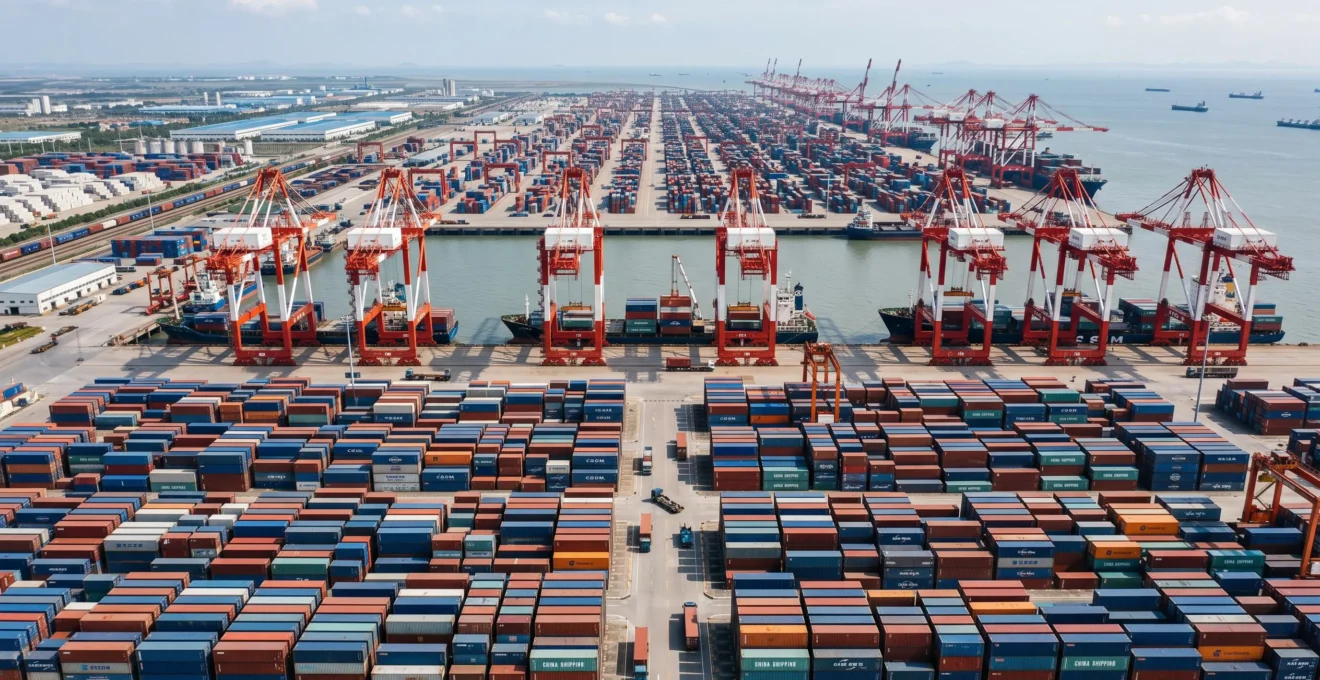
China’s supply chain infrastructure processes over 10 million daily cross-border ecommerce orders, connecting thousands of specialized manufacturing zones to distribution networks spanning six continents.
To effectively navigate this complex manufacturing landscape, businesses must implement robust operational frameworks that bridge the gap between production sites and international consumers. Utilizing comprehensive Apex Hub logistics solutions empowers brands to centralize their oversight, ensuring that every shipment meets specific quality standards while maintaining a steady flow through global distribution channels. This professional approach mitigates the risks of fragmented coordination and provides the reliability needed for sustainable international expansion.
Table of Contents
- Scale and economic gravity: why global ecommerce converges on China’s infrastructure
- Three manufacturing ecosystems that drive production at continental scale
- From factory floor to global destination: the logistics choreography
- Digital integration and quality assurance: the invisible coordination layer
Scale and economic gravity: why global ecommerce converges on China’s infrastructure
China maintains all 41 major industrial categories recognized in the UN’s industrial classification system—a breadth no other nation currently matches. This sectoral completeness means brands can source electronics components, textiles, packaging, and assembly labor within a 200kilometer radius rather than coordinating suppliers across multiple countries. According to official publications, cross-border ecommerce exports reached 2.15 trillion RMB in 2024, reflecting 16.9% year-on-year growth that outpaces most competing manufacturing regions.
Supplier density within specialized clusters creates operational advantages extending beyond cost arbitrage. When thousands of manufacturers concentrate in single industrial zones, they establish shared infrastructure for raw materials, component suppliers, quality testing laboratories, and logistics facilities. Industry observers estimate over 10 million daily cross-border orders now flow through China’s ecommerce fulfillment networks—transaction volumes that have enabled specialized services for small-batch production, custom packaging, and multi-channel distribution.
Your rapid briefing: how China’s supply chain powers global ecommerce
- China channels roughly 30% of global manufacturing output and handles 2.15 trillion RMB in annual cross-border ecommerce exports through concentrated industrial infrastructure
- Three regional manufacturing ecosystems specialize by sector: Pearl River Delta dominates electronics and consumer goods, Yangtze River Delta leads textiles and precision manufacturing, while inland hubs offer cost optimization
- Port networks processing 50+ million container units annually coordinate with freight consolidation systems to make small-batch ecommerce shipments economically viable
- Integrated AI-driven platforms now replace traditional fragmented agent models, reducing coordination overhead through automated workflows and real-time visibility
2.15 trillion
RMB
Cross-border ecommerce exports from China in 2024, representing 16.9% growth and demonstrating sustained infrastructure capacity expansion
Accessing this infrastructure historically required navigating fragmented service providers—manufacturers communicating only in Mandarin, freight forwarders with opaque pricing, quality inspectors with inconsistent protocols, and agents responding across 48-72 hour cycles. That fragmentation created coordination bottlenecks that industry practitioners estimate consumed 20+ hours weekly for brands managing multiple touchpoints manually. Platforms emerged to consolidate these layers, centralizing sourcing, quality control, warehousing, and shipping through AI-driven systems that automate supplier matching, inventory synchronization, and order routing. Where traditional models required separately contracting manufacturers, translators, inspection agencies, and freight brokers, integrated platforms now deliver end-to-end coordination as a single service layer, reducing coordination overhead to under 2 hours weekly.
Three manufacturing ecosystems that drive production at continental scale
China’s industrial capacity distributes across distinct geographic clusters, each offering specialized capabilities shaped by decades of sectoral concentration. Understanding these specialization patterns helps brands target sourcing toward regions aligned with their product categories.
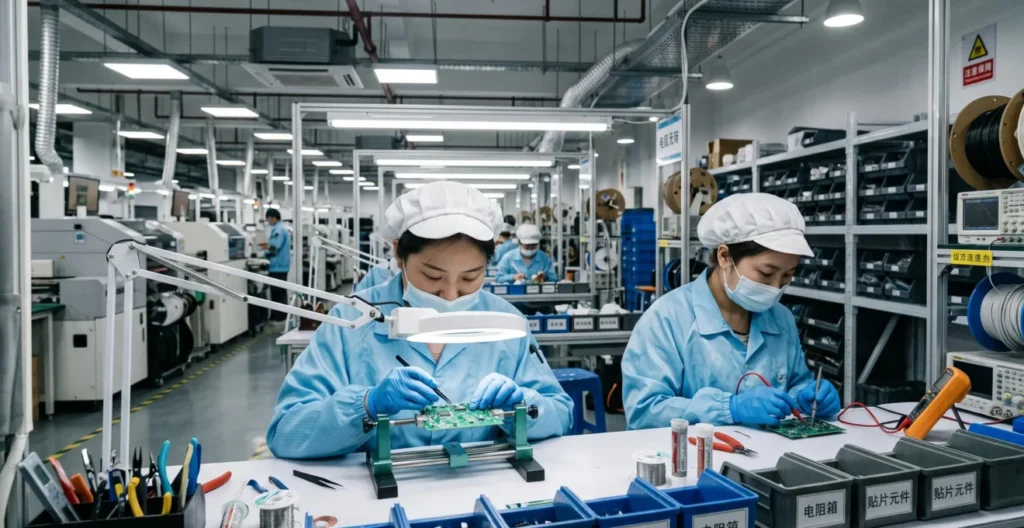
Pearl River Delta: electronics, consumer goods, and rapid prototyping density
The Guangdong province industrial belt surrounding Shenzhen concentrates electronics manufacturing at unmatched global density. Component suppliers, circuit board fabricators, and assembly operations cluster within logistics zones connected to port infrastructure, creating 24-48 hour prototyping cycles. This ecosystem supports high-mix, low-volume production models—manufacturers running dozens of product variants simultaneously rather than requiring single-SKU mass production commitments.
Yangtze River Delta: textiles, apparel, and high-precision manufacturing
Shanghai, Zhejiang, and Jiangsu provinces form an industrial corridor specializing in textiles, apparel, home goods, and precision-engineered components. Concentrated textile mills, dyeing facilities, and garment factories allow brands to source raw materials, complete production, and coordinate packaging within compact geographic areas. With such supplier concentration comes the critical challenge of distinguishing reliable manufacturers from inconsistent operators—systematic supplier evaluation protocols become essential when navigating these dense clusters.
Emerging inland hubs: cost arbitrage and specialized material processing
Chengdu, Chongqing, and central province manufacturing zones offer cost advantages as coastal labor and land prices have risen. Brands producing bulkier, lower-value-density products increasingly shift production inland where factory space and workforce costs run 20-30% below coastal equivalents. While inland locations add 3-5 days to ocean shipping timelines, cost differentials often justify extended lead times for margin-sensitive categories.
From factory floor to global destination: the logistics choreography
Understanding the physical journey from manufacturing completion to international delivery requires tracing coordination across port systems, freight consolidation networks, and customs clearance mechanisms.
Port infrastructure and container throughput: Shenzhen, Shanghai, Ningbo dominance
Three port complexes handle the majority of containerized exports. According to official statistics, Shanghai Port became the first globally to exceed 50 million TEUs in annual container throughput during 2024, maintaining its position as the world’s busiest container port for 14 consecutive years. The facility operates nearly 350 international shipping services connecting over 700 ports across more than 200 countries and regions. Automated container handling systems and dedicated ecommerce processing lanes compress port dwell times, allowing cargo to move from factory gate to vessel departure within 48-72 hours.
Freight forwarding and consolidation: how small shipments achieve economies of scale
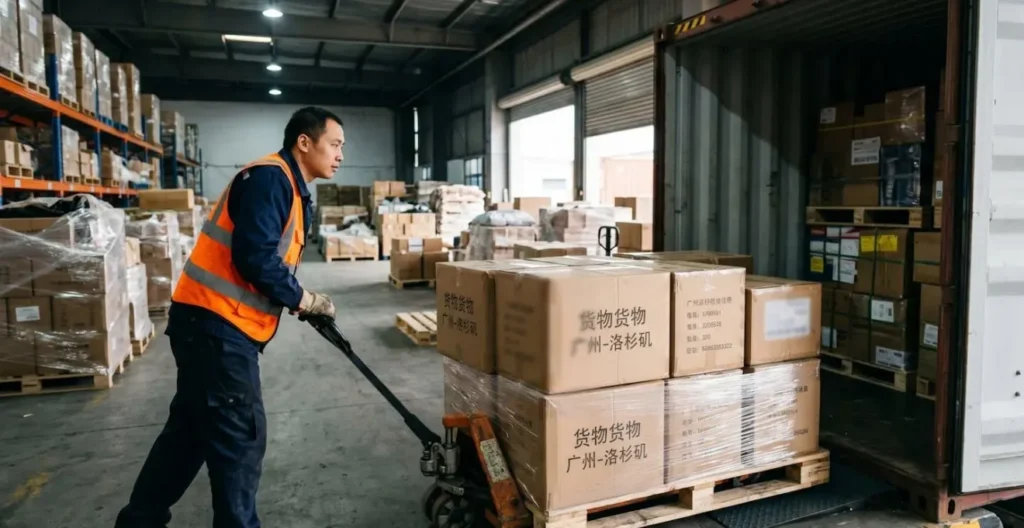
Ecommerce brands rarely fill entire containers with single-product shipments. Consolidation warehouses solve this by aggregating shipments from multiple brands into shared containers—Less than Container Load (LCL) shipping. Brands share container space and split fixed ocean freight costs, reducing per-unit transport expenses. Digital platforms with centralized visibility and automated routing have systematically streamlined this coordination, with freight forwarders scheduling regular container departures that provide predictable shipping windows.
Last-mile distribution and cross-border ecommerce regulations
China’s customs administration established specialized clearance frameworks to facilitate direct-to-consumer international shipments. The 9610 customs code targets B2C cross-border transactions, streamlining clearance through list verification. The Shanghai Free Trade Zone official portal documents that cross-border ecommerce exports via air cargo reached 245 million declarations in the first half of 2024, representing 36% year-on-year increase. Bonded warehouse zones allow inventory to enter China under suspended duty status, then clear customs when final destinations are confirmed.
Digital integration and quality assurance: the invisible coordination layer
The physical infrastructure forms only the visible portion of China’s supply chain capabilities. Beneath operates a technological coordination layer that determines whether brands experience systematic efficiency or chronic friction. Traditional approaches relied on human intermediaries—agents fielding email inquiries, translators bridging language gaps, inspectors scheduling ad-hoc visits. Each touchpoint introduced delay and opacity into processes now increasingly automated through platform integration.
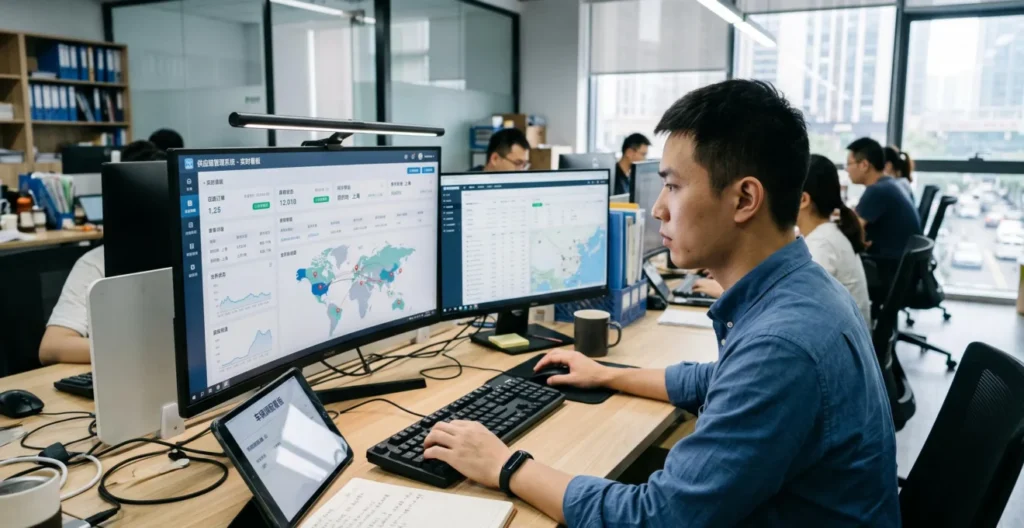
Consider a mid-sized electronics brand launching a new product line. Under traditional fragmented coordination, the founder spent hours weekly managing manufacturer quotes with 48-72 hour response cycles, negotiating specifications through translated exchanges, arranging quality inspections with scheduling conflicts extending timelines by weeks, and tracking shipments through forwarded emails with inconsistent detail. After adopting an integrated platform, the same operations require under 2 hours weekly through automated supplier matching, systematic quality checkpoints, and unified shipment dashboards—freeing capital and attention for product development.
| Dimension | Traditional Agent Model | Integrated Platform Approach |
|---|---|---|
| Communication response time | 48-72 hours across time zones | Real-time automated updates, 24/7 dashboard access |
| Weekly coordination overhead | 20+ hours managing multiple contacts | Under 2 hours through automated routing |
| Shipment visibility | Manual requests, 24-48 hour information lag | Live tracking dashboards, GPS container monitoring |
| Quality control consistency | Inconsistent protocols, ad-hoc scheduling | Systematic verification at production checkpoints |
| Cost transparency | Opaque pricing with fees surfacing during process | Itemized cost breakdowns upfront, consolidated billing |
Early platform adoption data suggests brands reduce supply chain coordination overhead by an estimated 80-90% compared to managing discrete service providers manually, while improving visibility through systematic process enforcement. The technology layer also addresses communication barriers—platforms employ AI-driven coordination interfaces with multilingual capabilities, eliminating language gaps that once required bilingual staff or external translation services.
Quality assurance particularly benefits from systematic digital integration. Rather than scheduling inspectors reactively, platforms embed verification checkpoints throughout production cycles—raw material inspection, in-process checks, pre-packaging verification, final pre-shipment audits. Photographic documentation flows into centralized dashboards where brands approve or flag issues before products leave factory premises, preventing scenarios where quality problems only surface weeks later upon destination-country delivery.
Do I need to speak Mandarin to source effectively from Chinese manufacturers?
Modern integrated platforms eliminate language barriers through built-in translation interfaces and English-fluent coordination teams. While speaking Mandarin provided advantages under traditional agent models, contemporary sourcing systems handle supplier communication, specification documentation, and quality verification in English as standard functionality. Brands operate successfully without language skills by leveraging platform intermediation that translates requirements into manufacturer specifications automatically.
What are typical minimum order quantities (MOQs) for custom products?
MOQs vary significantly by product complexity and manufacturer specialization. Consumer electronics components might require 500-1,000 unit minimums, while textile products and home goods often start at 200-300 units per design variant. Platforms with established manufacturer networks can sometimes negotiate lower MOQs by batching multiple brand orders with the same supplier, or by connecting brands with factories specializing in small-batch production models that serve ecommerce businesses specifically.
How do modern platforms ensure consistent quality control across suppliers?
Systematic verification protocols embedded at production milestones replace ad-hoc inspection scheduling. Platforms typically mandate raw material checks, in-process assembly verification, pre-packaging audits, and final pre-shipment inspections with photographic documentation at each stage. Brands approve samples before mass production begins, then receive visual confirmation that production batches match approved specifications. This multi-checkpoint approach catches deviations early rather than discovering issues only after international shipment arrives.
What lead times should I expect from production completion to international delivery?
Ocean freight from major Chinese ports to North American destinations typically requires 18-25 days, European ports 22-30 days, and Australian ports 12-18 days, plus 2-3 days for inland transport to port and 3-5 days for customs clearance and final delivery. Air freight reduces transit to 5-7 days but costs 4-6 times ocean rates. Consolidated LCL shipments may add 3-5 days compared to full-container loads due to warehouse aggregation timelines. Total lead times from production completion to customer delivery generally span 25-35 days for ocean freight, 10-14 days for air cargo.
How does China sourcing cost compare to domestic manufacturing when all factors are included?
Total landed costs depend on product category, order volumes, and destination markets, but China sourcing typically delivers 30-50% cost advantages for consumer goods, electronics, and textiles even after incorporating international freight, customs duties, and quality control expenses. Labor cost differentials remain significant for assembly-intensive products, while infrastructure density reduces raw material and component sourcing expenses. Brands should calculate landed costs including production, freight, duties, inspection fees, and inventory carrying costs rather than comparing factory-gate prices alone. Products requiring specialized certifications or rapid iteration cycles may narrow the cost advantage.