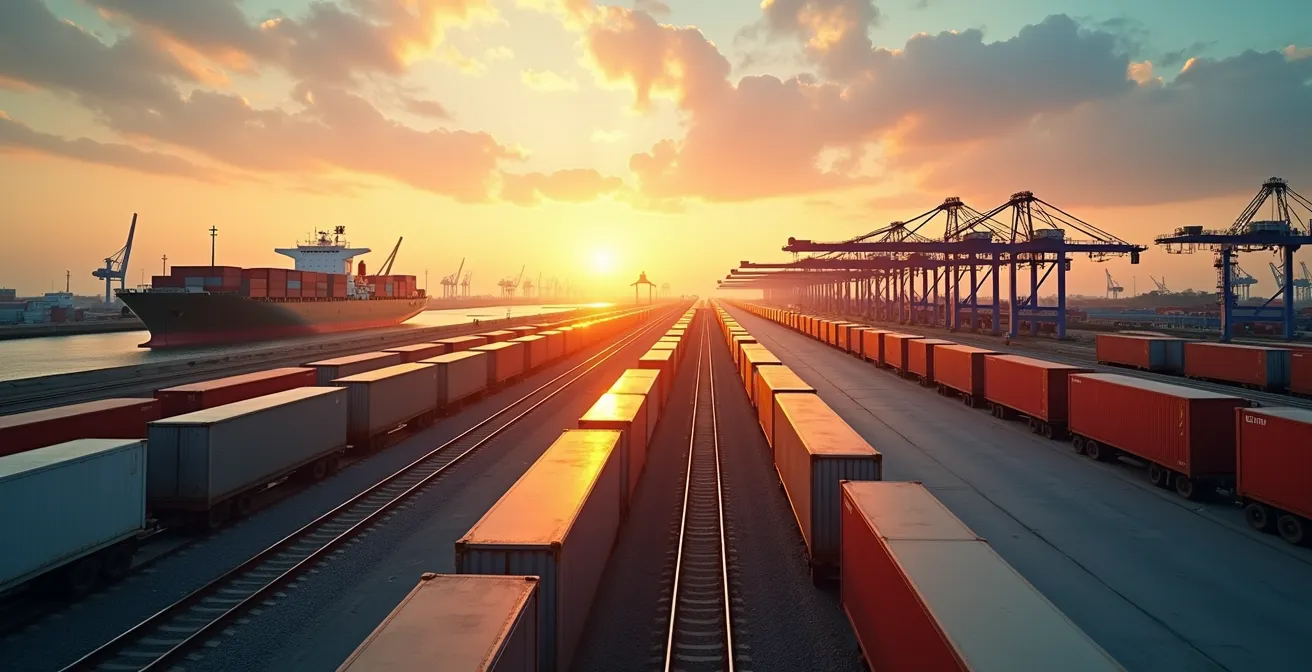
True multimodal optimization is not about finding the cheapest carrier; it’s about mastering the complex physical and digital handoffs between transport modes where costly inefficiencies occur.
- Physical stress, particularly harmonic vibration, is a primary cause of damage, not just random shocks.
- Data synchronization failures, not physical delays, are often the root cause of hours-long hold-ups at terminals.
Recommendation: Shift your focus from route planning to transfer point engineering—designing packaging, data flows, and contracts specifically for the stresses of intermodal switching.
For logistics planners managing complex global supply chains, the term “multimodal” represents both immense opportunity and significant risk. The promise of combining truck, rail, and sea transport offers unparalleled reach and cost-efficiency. However, the reality is often a gauntlet of delays, damaged goods, and escalating fees. Standard advice often revolves around generic platitudes like “improving communication” or “using tracking technology.” While not incorrect, this advice fails to address the core of the problem: the transfer points themselves.
These critical junctions—from port to rail yard, from rail yard to loading dock—are not simple handoffs. They are moments of intense physical stress and complex data exchange. The conventional approach of treating each leg of the journey as a separate segment is the fundamental flaw. But what if the key to unlocking true efficiency wasn’t in optimizing the routes, but in engineering the transfers? This requires a deeper, more technical understanding of the underlying forces at play.
This guide abandons generic advice to provide a route-focused, efficiency-driven framework. We will dissect the physics of cargo damage, the mechanics of loading dock delays, and the data architecture required for seamless synchronization. By focusing on mastering these integration points, you can transform multimodal transfers from a source of liability into a strategic competitive advantage.
This article provides a technical deep-dive into the critical points of failure and optimization within the multimodal journey. Below is a summary of the key areas we will dissect to build a more resilient and efficient supply chain.
Summary: A Technical Framework for Multimodal Transfer Optimization
- Why Goods Get Damaged During Intermodal Switching Points?
- Rail vs. Truck: Which Feeder Mode Offers Better Reliability?
- The Loading Dock Mistake That Delays Departure by Hours
- Designing Packaging for Multimodal Stress: Problem & Solution
- Synchronizing Arrival Times: A Sequence to Eliminate Waiting Fees
- Optimizing Distribution: The Hub-and-Spoke Solution Within Free Trade Zones
- Why Ocean Transit Is Often a “Black Hole” for Data?
- How to Negotiate Ocean Freight Contracts in a Carrier-Dominated Market?
Why Goods Get Damaged During Intermodal Switching Points?
The most common misconception about in-transit damage is that it results from isolated, high-impact events like drops or collisions. While these occur, the more insidious and costly culprit is cumulative stress, specifically harmonic vibration. Every mode of transport—truck, train, ship—produces vibrations at different frequencies. When a load is transferred, it’s subjected to a new vibrational profile, and the accumulated stress can cause catastrophic failure even without a single major shock. This is particularly true during rail transport, where consistent vibrations at specific speeds can match the natural frequency of a poorly secured load, amplifying the forces exponentially.

The damage is often invisible until it’s too late, presenting as compression, stress fractures in packaging, and product failure upon unboxing. While industry leaders have made progress, with Union Pacific confirming that only 0.2% of all intermodal rail freight gets damaged, this small percentage represents millions in losses for shippers. The solution lies not in adding more padding, but in engineering the entire load to counteract these specific forces. This involves understanding the unique vibration signature of your chosen route and implementing precise blocking and bracing techniques designed to dampen or alter the harmonic response of the cargo.
To prevent this cumulative damage, a proactive, physics-based approach to load securing is essential. The following steps form a baseline for mitigating vibration-related risks:
- Understand Load-Specific Frequencies: Recognize that harmonic vibration occurs at specific speeds unique to each load’s density and how it’s packed.
- Implement Proper Blocking and Bracing: Use materials like 2x4s secured with 16d nails to create a rigid structure that can withstand both lateral and longitudinal forces common in rail transport.
- Monitor Axle Weight Distribution: Ensure weight is evenly distributed to avoid creating pivot points that can exacerbate vibrations and lead to overweight violations.
- Test Packaging for Route-Specific Stress: Whenever possible, test your packaging and loading configurations at frequencies that match your specific vessel-rail-truck route combination to identify weaknesses before shipping.
Rail vs. Truck: Which Feeder Mode Offers Better Reliability?
The choice between rail and truck for feeder services—the short-haul transport connecting a port to an inland hub—is a critical decision that directly impacts cargo integrity. The answer isn’t about which mode is “better,” but which is better suited to the physical properties of your cargo. Reliability here is defined by the predictability of the shock and vibration environment. Trucks and trains expose cargo to fundamentally different types of stress.
Trucks typically produce more severe, low-frequency shocks (around 10 Hz) due to road imperfections, while rail transport is characterized by higher-frequency vibrations (often above 100 Hz) from the wheel-rail interface. This technical distinction is paramount. A product with a high natural frequency might be perfectly safe on a truck but could be damaged by the high-frequency environment of a train, and vice-versa. For instance, the flat-pack furniture design perfected by IKEA is not just for saving space; its dense, compact nature makes it inherently robust against the varied stresses of a supply chain that seamlessly blends maritime, rail, and road transport.
Analyzing the cargo’s sensitivity to specific frequencies is a mark of advanced logistics planning. As the following comparative data from a U.S. Department of Energy study shows, matching the cargo to the transport environment is a science. This analysis, focused on nuclear material transport, provides an invaluable framework for any high-value goods.
| Transport Mode | Frequency Range | Shock Severity | Best For Cargo Type |
|---|---|---|---|
| Truck | 10 Hz recurrent shock | More severe at low frequencies | High natural-frequency cargo |
| Rail | Above 100 Hz | More severe at high frequencies | Low natural-frequency cargo (below 15 Hz) |
| Special Suspension Trucks | Variable | Reduced with air/elastomeric systems | Massive cargo (3-60 Hz range) |
As this breakdown of transport shock environments reveals, massive or delicate cargo with low natural frequencies below 15 Hz is often safer on rails, while more compact, rigid items can better withstand the recurrent shocks of truck transport. The most sophisticated shippers utilize specialized suspension systems to create a custom environment when the value or fragility of the cargo justifies the cost.
The Loading Dock Mistake That Delays Departure by Hours
A common bottleneck in the intermodal chain isn’t a lack of trucks or a delayed vessel; it’s a simple mismatch of information at the loading dock. A departure can be delayed for hours because the physical truck arriving at the gate does not match the digital entry in the Terminal Operating System (TOS). This data discrepancy triggers a cascade of manual interventions, phone calls, and system overrides that brings the loading sequence to a halt. While it seems like a minor clerical error, it represents a fundamental failure in process synchronization.

The root cause is often outdated master data—incorrect container weights, obsolete truck information, or a failure to update the system after a last-minute change. In a high-volume environment, there is zero buffer for such exceptions. The solution is to treat data accuracy with the same rigor as physical asset management. This means auditing master data weeks before a shipment is scheduled and implementing a robust pre-arrival validation process. Modern logistics control centers are not just monitoring vehicle locations; they are running continuous data integrity checks to ensure the digital and physical worlds are perfectly aligned before a truck ever reaches the terminal gate.
To prevent these costly data-driven delays, a meticulous pre-loading and data verification process is required. Implementing a rigorous checklist can transform the loading dock from a bottleneck into a high-efficiency transfer point.
Action Plan: Loading Dock Data and Process Synchronization
- Create a Detailed Load Diagram: Develop and share a precise load plan with the terminal *before* the loading process begins to pre-emptively identify issues.
- Verify TOS and Physical Presence: Implement a system to ensure the digital entry in the Terminal Operating System perfectly matches the physical truck and container information upon arrival.
- Implement Buffer Capacity in Scheduling: Build flexibility into terminal appointment scheduling systems to absorb minor, unavoidable deviations without causing a complete shutdown.
- Audit Master Data for Accuracy: Weeks before shipment, conduct a full audit of all master data related to the consignment, focusing on weight and dimension accuracy.
- Test Packaging and Loading Alignment: Confirm that the planned packaging system (e.g., pallets, slip sheets) aligns with the terminal’s planned loading configuration and equipment.
Designing Packaging for Multimodal Stress: Problem & Solution
Standard packaging is often designed to withstand a single drop from a specific height. This “pass/fail” approach is dangerously inadequate for multimodal transport. The real challenge is not a single impact but a journey of a thousand micro-stresses: the low-frequency bumps of a truck, the high-frequency vibration of rail, the pitching and rolling of a vessel, and the shocks of being lifted and stacked at a terminal. Research into parcel shipments has revealed a brutal environment, with some packages experiencing shock events exceeding 100g—an astonishing force for any product to endure.
The solution is to move from generic packaging to route-specific packaging engineering. This involves using simulation software to model the combined vibration and shock profiles of a planned multimodal route. Instead of just adding more foam, this approach allows for the selection of materials with specific frequency-dampening properties tailored to the journey. For temperature-sensitive goods, it means integrating phase-change materials that can maintain thermal stability during long waits at sun-baked ports or cold rail yards.
This is the essence of smart packaging: it is not just a container but an engineered system designed to protect the asset within from a predictable, albeit harsh, environment. The design must also account for the end of the line, conforming to standardized container dimensions like 20-foot TEUs or 40-foot FEUs to ensure seamless handling by global port infrastructure.
Implementing a smart packaging strategy requires a shift from a materials-based approach to a data-driven one. A robust implementation follows a clear, strategic sequence:
- Embed Low-Cost Sensors: For high-value goods, embed sensors to monitor shock, tilt, humidity, and temperature, providing real-world data on transit conditions.
- Simulate Combined Vibration Profiles: Use specialized software to model the cumulative stress from the specific truck-rail-vessel combination of your route.
- Select Materials Based on Dampening Needs: Choose packaging materials based on their proven ability to dampen the specific frequencies identified in the simulation.
- Integrate Thermal Stability Solutions: For sensitive cargo, implement phase-change materials to manage temperature fluctuations during transfers and dwell times.
- Standardize Dimensions: Ensure all final packaging configurations are designed for optimal fit within standardized 20-foot (TEU) or 40-foot (FEU) containers to maximize space and ensure compatibility with handling equipment.
Synchronizing Arrival Times: A Sequence to Eliminate Waiting Fees
Demurrage and detention fees are not a cost of doing business; they are a tax on poor synchronization. These fees accumulate when a container is not moved from the port or a truck is left waiting, and their root cause is almost always a reliance on static schedules instead of dynamic, real-time data. A vessel’s scheduled arrival time is a plan, not a reality. Relying on it to schedule drayage trucks or rail transport is a recipe for expensive waiting.
The solution is to create a “digital baton pass” between transport modes. This means replacing outdated EDI (Electronic Data Interchange) systems with modern API (Application Programming Interface) integrations that provide a live, shared view of a shipment’s progress. Instead of relying on a carrier’s unverifiable ETA, this system blends data from on-container sensors, vessel AIS (Automatic Identification System), and traffic data to generate a predictive ETA that is constantly updated. This is like virtually traveling with your shipment every step of the way.
With this shared, real-time visibility, port and terminal resources can be scheduled based on when a shipment *will* arrive, not when it was *supposed* to. A drayage truck can be dispatched to arrive minutes after the container is offloaded, not hours. This proactive approach turns a reactive, chaotic process into a choreographed sequence, drastically reducing dwell times and virtually eliminating waiting fees.
Transitioning from static schedules to a dynamic “virtual baton pass” requires a systematic upgrade of data infrastructure and operational playbooks. The process involves several key steps:
- Deploy Predictive ETA Systems: Implement systems that aggregate data from all transport modes to generate a continuously updated, predictive Estimated Time of Arrival.
- Replace EDI with Real-Time APIs: Move away from periodic, batch-based EDI updates to direct API integrations for a live flow of information.
- Create Shared Visibility Platforms: Provide all stakeholders (shipper, carrier, terminal, drayage) with access to a single, unified platform showing the real-time status of the shipment.
- Schedule Resources Based on Predicted Arrivals: Shift operational procedures to schedule labor and equipment based on predictive ETAs, not static schedules.
- Implement Proactive Demurrage Playbooks: Develop pre-defined action plans for common delay scenarios to manage exceptions and mitigate potential fees before they are incurred.
Optimizing Distribution: The Hub-and-Spoke Solution Within Free Trade Zones
For companies with complex global distribution networks, the hub-and-spoke model is a classic strategy. However, its power is magnified when the “hub” is strategically placed within a Free Trade Zone (FTZ). An FTZ is a secured area that, for customs purposes, is considered outside the host country’s territory. This creates a powerful platform for optimizing inventory, deferring duties, and increasing supply chain agility.
By positioning a central distribution hub in a geopolitical pivot point like Dubai, Singapore, or Panama, companies can hold inventory in a customs-neutral location. This allows for rapid rerouting of goods to different continents based on last-minute shifts in market demand, without the customs complexities of moving goods out of one country and into another. E-commerce giant Amazon masterfully uses this strategy, leveraging FTZs for strategic inventory positioning to enable rapid fulfillment across its vast, integrated network of air, road, and rail transport.
The most advanced FTZ strategies involve duty inversion. Companies can import components into the FTZ at a low or zero duty rate, perform light assembly or kitting operations within the zone, and then export the finished product. If the duty rate on the finished product is lower than the rate on the individual components would have been, the company realizes significant savings. This transforms the distribution hub from a simple storage facility into a value-adding link in the supply chain.
Effectively leveraging a Free Trade Zone requires more than just renting warehouse space. It demands a strategic framework that integrates logistics, finance, and market forecasting:
- Identify Geopolitical Pivot Points: Select FTZ locations that serve as natural crossroads for your key trade lanes, such as Dubai, Singapore, or Panama.
- Establish Light Assembly Operations: Set up capabilities for kitting, bundling, or light assembly within the FTZ to add value and alter customs classifications.
- Delay Final Product Configuration: Postpone the final configuration or localization of products until market-specific demand is confirmed, increasing inventory flexibility.
- Implement Duty Inversion Strategies: Analyze tariff schedules to identify opportunities where importing components and assembling in the FTZ results in a lower overall duty burden.
- Build Flexibility for Rerouting: Design the hub’s operational model to support rapid, last-minute rerouting of inventory to different continental markets based on real-time demand signals.
Why Ocean Transit Is Often a “Black Hole” for Data?
For all the advancements in logistics technology, the moment a container is loaded onto a vessel, it often enters a data “black hole.” For weeks at a time, shippers have little to no visibility into the location, condition, or security of their goods beyond what the carrier chooses to share. This lack of data is a massive liability, making it impossible to react to delays, manage inventory effectively, or verify that transport conditions (like temperature) are being met. The problem is twofold: the high cost of satellite data transmission from the open ocean and the “walled garden” approach of many ocean carriers who are reluctant to share their data.
Breaking through these barriers is possible with a combination of modern technology and savvy negotiation. The first step is to equip containers with sensors capable of on-container edge computing. Instead of constantly transmitting large amounts of data via expensive VSAT connections, the on-board device processes data locally. It only transmits small, critical alerts—such as a temperature deviation, a severe shock, or a door-open event—when a threshold is breached.
The second step is to bypass carrier data silos by using neutral data aggregation platforms and, crucially, by writing API access requirements directly into freight contracts. This contractually obligates the carrier to provide a direct feed of operational data. When executed properly, this creates a blended intelligence system that, according to the Global Multimodal Freight Transportation Market report, can improve transportation efficiency by up to 30%. It transforms ocean transit from an opaque black hole into a transparent, manageable leg of the journey.
Illuminating the data black hole of ocean transit requires a multi-pronged technical and commercial strategy. The following actions are critical to gaining true container-level visibility at sea:
- Deploy On-Container Edge Computing: Use smart sensors that process data locally on the container, reducing reliance on constant, expensive satellite data transmission.
- Transmit Only Critical Alerts: Configure systems to transmit only essential alerts (e.g., temperature breach, shock event) via satellite to control costs.
- Negotiate API Access in Contracts: Make real-time data access via API a mandatory, non-negotiable clause in all ocean carrier contracts.
- Use Neutral Data Aggregators: Partner with third-party platforms that can aggregate data from multiple carriers and sources to create a single, unbiased view of all shipments.
- Implement Container-Level Sensors: Deploy a full suite of sensors to monitor not just location but also critical conditions like temperature, humidity, shock, and door-open events.
Key Takeaways
- Damage is often caused by predictable harmonic vibrations specific to a route, not random accidents.
- Data synchronization at terminals is as critical as physical handling; a digital mismatch can halt operations for hours.
- Contract negotiation must evolve from a simple rate discussion to a strategic partnership based on shared data and performance metrics.
How to Negotiate Ocean Freight Contracts in a Carrier-Dominated Market?
In a market where ocean carriers hold significant leverage, many shippers feel they are forced to accept standard terms and rates. However, sophisticated shippers can shift the balance of power by changing the basis of the negotiation. Instead of focusing solely on the per-container rate, the strategic approach is to negotiate on data, flexibility, and performance. This means positioning yourself as a “shipper of choice”—a partner who provides reliable volume forecasts, ensures data accuracy, and minimizes exceptions.
This data-driven approach opens the door to negotiating terms that are far more valuable than a small rate reduction. For example, instead of a fixed annual rate, you can negotiate a hybrid index-linked model that allows you to benefit from market downturns. You can negotiate for extended free time at ports to reduce detention fees or demand that the carrier commits to specific performance metrics. A 3PL with multimodal expertise can often leverage their aggregate volume and data to secure these superior terms on your behalf.
The most impactful negotiations often happen around ancillary fees. By analyzing your own performance data, you can prove your efficiency and use it as leverage to negotiate caps on demurrage and detention charges, potentially saving over $100 per container. This transforms the contract from a simple transport agreement into a strategic partnership with shared risk and reward.
To succeed in a carrier-dominated market, shippers must move beyond traditional negotiation tactics. The focus must shift from pure cost leverage to a strategic, data-backed partnership model. The following comparison highlights the key differences in approach.
| Negotiation Focus | Traditional Approach | Strategic Approach | Potential Savings |
|---|---|---|---|
| Rate Structure | Fixed annual rate | Index-linked hybrid model | Captures market downside |
| Free Time | Standard terms | Extended free time negotiation | Reduces detention fees |
| Performance Data | Volume-based leverage | Shipper-of-choice metrics | Earns preferential treatment |
| Demurrage Caps | Accept standard fees | Negotiate fee caps | Can save >$100/FEU |
As this strategic breakdown of negotiation points illustrates, the greatest value is often found outside the base freight rate. By focusing on these areas, shippers can build more resilient and cost-effective relationships with their carriers, even when market conditions are challenging.
To put these strategies into practice, the next logical step is to conduct a comprehensive audit of your current multimodal routes, focusing specifically on transfer point vulnerabilities and data flow inefficiencies.