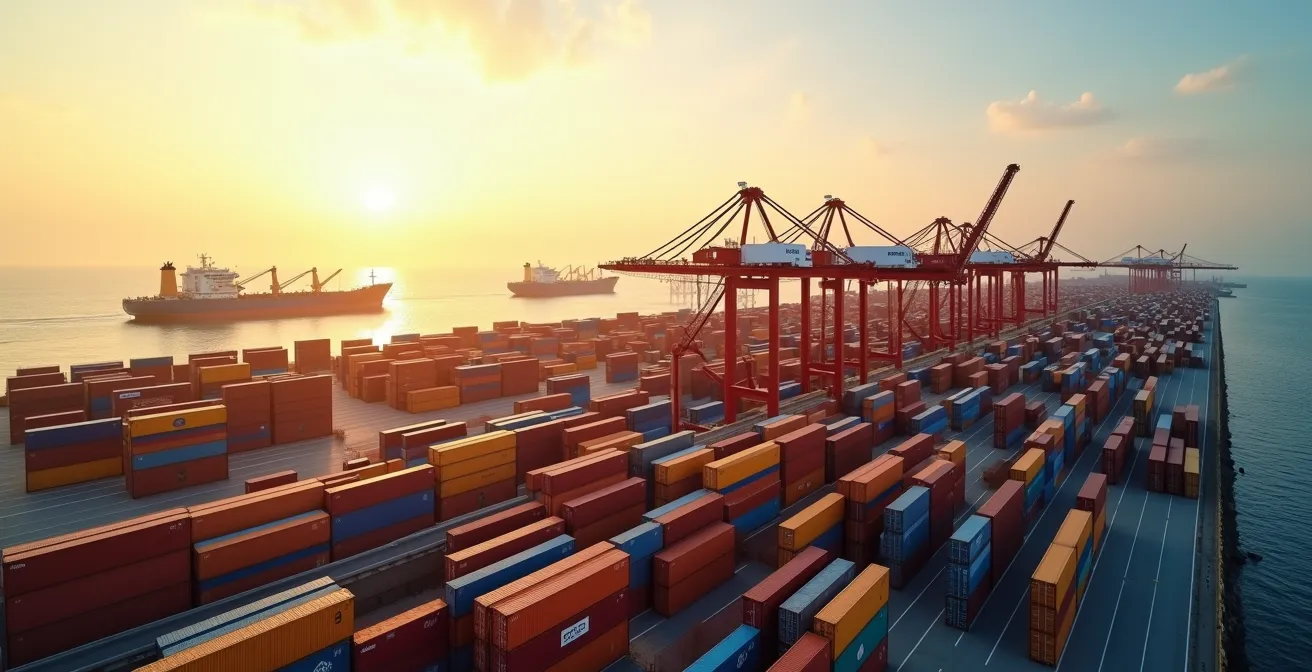
Demurrage is not a cost of doing business; it’s a symptom of broken synchronization that can be engineered out of your supply chain.
- Proactive customs pre-clearance and strategic free time negotiation are your first lines of defense against predictable fees.
- Real-time, multi-source visibility isn’t just for tracking; it’s for predicting and preventing delays before they start a cascade of costs.
Recommendation: Implement a reverse-engineered logistics timeline, synchronizing customs, drayage, and warehouse appointments to eliminate waiting time at every step.
For any logistics coordinator, the sight of demurrage fees piling up on a container that has already been customs-cleared is a unique kind of frustration. It feels like paying rent for a space you’re desperately trying to vacate. The common advice—”track your shipments,” “work with a good forwarder”—is true, but it’s table stakes. It doesn’t address the core issue: in a congested port environment, your container is not a single item but a needle in a massive, chaotic haystack, and getting it out is a battle against time, bureaucracy, and physics.
The total financial damage is staggering. According to the Federal Maritime Commission, ocean carriers collected a colossal $15.4 billion in detention and demurrage charges between April 2020 and March 2025 alone. This isn’t just a nuisance; it’s a significant and often avoidable drain on your budget. The key to stopping this financial bleed isn’t just about moving faster. It’s about moving smarter by treating your supply chain not as a series of sequential handoffs, but as a single, synchronized system.
This guide abandons the generic advice. Instead, we will dissect the five most common failure points where synchronization breaks down and provide tactical, pre-emptive strategies a port operations specialist would use. We will explore how to pre-clear documents while cargo is still at sea, why weekends are a financial minefield, and how to build a logistical sequence that makes waiting fees a relic of the past.
Table of Contents: A Tactical Guide to Eliminating Port Fees
- Why Containers Get Stuck at Terminals Despite Being Cleared?
- How to Pre-Clear Customs Documents Before the Vessel Arrives?
- The Risk of Ignoring Free Time Expiration Dates on Weekends
- Negotiating Extended Free Time: Problem & Solution for High Volume
- Demurrage vs. Detention: Which Fee Are You Actually Paying?
- Why Ocean Transit Is Often a “Black Hole” for Data?
- Securing Containers: Problem & Solution During Peak Season
- Synchronizing Arrival Times: A Sequence to Eliminate Waiting Fees
Why Containers Get Stuck at Terminals Despite Being Cleared?
The most infuriating phrase in logistics is “cleared but not available.” Your container has been released by customs, but it’s physically inaccessible—buried under hundreds of other boxes in a terminal stack or blocked by equipment shortages. This isn’t a fluke; it’s a systemic symptom of port congestion, where terminal operations cannot keep pace with vessel arrivals. The severe congestion at the San Pedro Bay port complex from 2020-2022, where over 100 vessels were at anchor, is a stark reminder of how vulnerable these systems are to volume surges. Even with subsequent infrastructure improvements, the risk remains.
A “cleared” status is only a legal milestone, not a physical one. The clock on your free time starts ticking regardless of whether a chassis is available or a crane can reach your container. The terminal’s primary goal is to unload the vessel as quickly as possible, not to facilitate your specific pickup. This disconnect is where demurrage fees are born. You are paying for the terminal’s inability to synchronize its yard operations with your need for timely retrieval.
To fight this, you must shift your focus from the customs milestone to the gate-out milestone. This requires terminal-level visibility to monitor if your container is in an accessible location or stuck in a “buried” stack. Documenting every instance of non-availability is crucial for disputing charges, proving that the delay was outside your control and a failure of the terminal’s obligation to provide access.
How to Pre-Clear Customs Documents Before the Vessel Arrives?
The single most effective pre-emptive strike against demurrage is ensuring your container is cleared by customs before it’s even discharged from the vessel. Waiting for the ship to dock before submitting paperwork is a rookie mistake that surrenders your most valuable asset: time. The goal is a zero-error, zero-delay customs process that happens in parallel with the ocean transit, not after it. Industry analysis shows that a startling 30% of customs delays leading to demurrage are caused by simple documentation errors.
This process demands a rigorous pre-arrival audit. At least seven days before the vessel’s ETA, all commercial documents, invoices, and packing lists must be cross-referenced. The key is to verify HS codes for correct classification and ensure the declared value is accurate to avoid flags from customs or Partner Government Agencies (PGAs). Modern electronic filing systems allow you to submit this documentation for pre-clearance while the cargo is still days away at sea. This transforms transit time from a passive waiting period into an active administrative window.
Using AI-powered compliance tools can further automate this audit, flagging potential discrepancies that a manual review might miss. Establishing a clear checklist for PGA requirements and having backup documentation protocols in place for potential holds are not optional—they are essential components of a resilient, cost-saving customs strategy.

By treating document submission as an urgent pre-op procedure rather than a post-arrival task, you effectively buy yourself days of buffer. When the container is discharged, it’s already greenlit, allowing you to focus immediately on the next logistical step: securing a truck and getting it out of the port.
The Risk of Ignoring Free Time Expiration Dates on Weekends
A container that arrives on a Thursday afternoon is a ticking time bomb. If your free time is three calendar days, it expires on Sunday. With the terminal closed or operating on skeletal staff, you have effectively lost a day and a half of viable pickup time. Come Monday morning, you are already on the clock for demurrage. This is the “weekend fee cascade”—a common but entirely preventable scenario where a small scheduling misalignment triggers a chain reaction of charges.
The critical error is confusing calendar days with working days. Many carrier contracts default to calendar days for free time, a clause that heavily favors them during weekend or holiday arrivals. A proactive logistics coordinator scrutinizes this part of the contract and fights to define free time in terms of working days. When this isn’t possible, an aggressive, pre-emptive approach is the only alternative.
One major importer combatted this by implementing a “Thursday Pre-Emptive Check” protocol. Every Thursday, they review a list of all containers with ETAs that could result in a weekend expiration. For these high-risk shipments, they immediately work to schedule drayage for Friday, even if it means paying a small premium for priority service. This proactive measure prevents the container from sitting idle over the weekend. The result of this strategy was a 40% reduction in weekend-related detention charges, proving that a small amount of foresight can prevent a large amount of fees.
Ignoring the calendar is one of the fastest ways to burn money in logistics. You must operate with the assumption that every weekend is a potential trap and plan your pickups with the urgency of a Friday afternoon deadline, no matter the day of arrival.
Negotiating Extended Free Time: Problem & Solution for High Volume
In logistics, leverage is measured in volume. While a small shipper might be at the mercy of standard carrier contracts, a high-volume importer has the power to rewrite the rules. Negotiating extended free time isn’t about asking for a favor; it’s a strategic conversation based on the value of your annual business. Data from volume-based negotiations show that large importers moving 1000+ TEUs annually can secure 10-14 days of free time, a stark contrast to the standard 3-5 days offered to smaller players.
This negotiation should happen during the annual contract review, not on a per-shipment basis. The goal is to codify extended free time as a standard term for all your shipments. For mid-tier shippers (100-500 TEUs/year), while custom agreements may be out of reach, negotiating for a consistent 5-7 days and the ability to request extensions without penalty is a realistic goal. For shippers with less volume, the most effective strategy is to pool your cargo with a Non-Vessel Operating Common Carrier (NVOCC) or a Third-Party Logistics (3PL) provider. This allows you to benefit from their collective bargaining power.
The most sophisticated high-volume shippers go beyond simple day extensions. They negotiate for “fee credit banks” or a cap on the total demurrage that can be accrued per container, effectively creating a financial backstop against catastrophic delays. The key is to understand where you fall on the volume spectrum and use the appropriate leverage, as outlined in the table below.
| Volume Tier (TEUs/year) | Typical Free Days | Negotiation Leverage | Alternative Strategies |
|---|---|---|---|
| <100 | 3-5 days | Low – Individual rates | Pool with NVOCC or 3PL |
| 100-500 | 5-7 days | Moderate – Can request extensions | Negotiate tiered rates by port |
| 500-1000 | 7-10 days | Strong – Annual contract terms | Fee credit banks available |
| >1000 | 10-14 days | Maximum – Custom agreements | Cap total demurrage per container |
Ultimately, free time is a commodity. By understanding its market value and your position within it, you can transform it from a rigid constraint into a flexible, negotiated buffer that shields you from unforeseen port delays.
Demurrage vs. Detention: Which Fee Are You Actually Paying?
When you receive an invoice for extra charges, the first step is to identify the enemy. Are you paying demurrage or detention? The terms are often used interchangeably, but they are fundamentally different, and knowing which one applies is critical for any dispute. With recent analysis revealing an 8% year-on-year increase in average global demurrage and detention charges in 2025, this distinction has never been more important.
Here’s the simple breakdown:
- Demurrage is a charge for using the container *inside* the terminal beyond the allotted free time. Think of it as a penalty for not picking up your box fast enough.
- Detention (also known as per diem) is a charge for using the container *outside* the terminal beyond the free time. This is a penalty for not returning the empty container to the carrier quickly enough.
This distinction is crucial because your ability to control the outcome differs. Demurrage is often tied to port congestion, terminal inefficiency, or customs delays—factors that may be outside your direct control. Detention, on the other hand, is typically related to your (or your consignee’s) warehouse operations, such as delays in unloading the container. Knowing this helps you focus your preventative efforts. If your biggest issue is demurrage, you need to optimize port-side operations. If it’s detention, you need to streamline your warehouse receiving process.

When you do face a fee, a properly documented dispute can be your best weapon. The Federal Maritime Commission’s (FMC) Final Rule on Demurrage and Detention states that charges should only be levied against the party in a position to prevent the delay. If the terminal could not provide an appointment or if your container was inaccessible, you have a strong case for disputing demurrage. Building a robust documentation trail is key to winning these disputes.
Your Fee Dispute Documentation Checklist: A Tactical Guide
- Appointment Screenshots: Capture proof of all terminal appointment systems showing no available slots during the free time period.
- Communication Logs: Document every call, email, and portal message with the carrier and terminal regarding pickup delays, including timestamps and representative names.
- FMC Rule Reference: Explicitly cite the FMC Final Rule in your dispute, arguing that as you were not in a position to mitigate the delay, the charges are invalid.
- Event Timestamps: Compile a clear, chronological event log (vessel arrival, customs clearance, free time expiry, first available appointment) to build an auditable timeline.
- Public Tariff Clauses: Reference any relevant clauses from the carrier’s or terminal’s public tariff that support your case regarding equipment availability or terminal obligations.
Why Ocean Transit Is Often a “Black Hole” for Data?
For weeks, your container is a ghost. You have a booking number and an ETA, but between the port of loading and the port of discharge, real-time information is scarce. This is the ocean transit “black hole,” a significant visibility gap created by fragmented communication and siloed data systems. Each entity in the chain—the carrier, the terminal operator, customs, the drayage company—has its own data, but they rarely share it effectively. This lack of a single source of truth makes proactive planning nearly impossible.
The 2025 congestion at the port of Singapore, a major global transshipment hub, illustrates this perfectly. Data silos between terminal operators and carriers created massive visibility gaps. Shippers couldn’t get reliable information on their transshipped containers, leading to missed connections and backlogs that rippled across Southeast Asia. When the system’s nodes don’t talk to each other, the entire network seizes up, and the shipper is left in the dark, unable to plan for drayage or warehouse receiving.
Escaping this black hole requires creating your own light. This means moving beyond relying on basic carrier milestone data (which is often delayed or inaccurate) and investing in a logistics control tower approach. This involves using predictive visibility platforms that aggregate data from multiple sources: AIS vessel tracking, port terminal APIs, carrier EDI feeds, and even satellite data. These platforms don’t just tell you where your container was; they use AI and machine learning to predict where it will be and, more importantly, flag shipments that are at high risk for delays.
The goal is to create a centralized dashboard that provides a single, unified view of your entire in-transit inventory. By setting up real-time alerts for critical events, such as a container showing no activity 24 hours after discharge, you can identify problems the moment they arise and take corrective action before they turn into costly demurrage charges.
Securing Containers: Problem & Solution During Peak Season
Peak season is a zero-sum game. When demand outstrips supply, every slot on a vessel and every container in a yard becomes a prized commodity. During these periods, simply having a booking doesn’t guarantee your cargo will move. Carriers prioritize their highest-paying or highest-volume customers, and smaller shippers often find their cargo “rolled” to a later sailing. With industry data revealing 20-30% higher congestion at U.S. West Coast ports in Q1 2025 compared to the previous year, securing capacity has become a primary strategic challenge.
Relying on the spot market during peak season is a recipe for disaster. While it offers flexibility, reliability plummets to 60-70%, and you are exposed to extreme rate volatility. The key to surviving—and thriving—during peak season is to have a diversified procurement strategy that balances cost and reliability. For shippers with predictable volumes, fixed annual contracts are the bedrock. They lock in rates and capacity, providing a reliability rate of 85-90% at a minimal cost premium.
For time-sensitive cargo, even within a contract, carriers offer “premium” services. These come at a 15-20% cost premium but offer a near-guaranteed loading and priority discharge, with reliability rates hitting 95-98%. For small to medium-sized shippers, partnering with a strong NVOCC provides a blend of secured space and manageable costs. The crucial step is to analyze your cargo’s urgency and your budget to select the right tool for the job.
| Strategy | Cost Premium | Reliability Rate | Best Use Case |
|---|---|---|---|
| Fixed Annual Contracts | 0-5% | 85-90% | Predictable volume shippers |
| Premium Carrier Services | 15-20% | 95-98% | Time-sensitive cargo |
| NVOCC Partnerships | 10-15% | 80-85% | Small-medium shippers |
| Spot Market Booking | Variable | 60-70% | Flexible, non-urgent cargo |
A successful peak season strategy isn’t about finding the cheapest option. It’s about building a resilient portfolio of shipping solutions that guarantees your most critical cargo moves on time, preventing downstream stockouts and production delays that are far more costly than any freight premium.
Key Takeaways
- Demurrage is a synchronization failure, not an inevitable cost of business; it can be engineered out of your processes.
- Proactive documentation, pre-clearance, and aggressive free time negotiation are your most powerful, non-negotiable tools for cost prevention.
- True visibility requires moving beyond carrier data and building a logistics control tower with multi-source, predictive analytics to escape the data “black hole.”
Synchronizing Arrival Times: A Sequence to Eliminate Waiting Fees
The ultimate strategy to eliminate demurrage and detention is total logistics synchronization. This means orchestrating every step—customs, warehousing, and trucking—to function as a single, harmonious system. The common mistake is to book these services sequentially and independently. A truck is booked, then the warehouse is called, only to find there are no appointments. This disjointed approach creates friction, delays, and, ultimately, fees. The solution is a reverse-engineered timeline planned backward from the final delivery date.
The sequence is everything. You must secure confirmation of each step before initiating the next. For example, a truck should never be dispatched until you have verified confirmation of customs release, freight payment, and, crucially, a confirmed warehouse appointment. This prevents drivers from arriving at a closed door or a backed-up facility, which immediately starts the detention clock.
Here is the tactical sequence for total synchronization:
- Step 1: Pre-Arrival Confirmation: Before the vessel even docks, confirm customs payment is settled and freight release is issued by the carrier.
- Step 2: Warehouse Pre-Booking: Secure a warehouse receiving appointment that aligns with the vessel’s ETA and expected discharge date.
- Step 3: Truck Appointment: Only after steps 1 and 2 are confirmed, book a drayage appointment at the port terminal.
- Step 4: Dispatch Verification: Dispatch the truck only when all three prior steps are confirmed and documentation is verified. This is the final green light.
This disciplined sequence was put to the test at the Port of Charleston, which experienced significant vessel delays. Successful shippers used appointment-setting software integrated with real-time vessel tracking. By synchronizing truck arrivals with the *actual* discharge times rather than the scheduled ETAs, they achieved a 40% reduction in waiting fees. They stopped reacting to the port’s schedule and started imposing their own synchronized order on the chaos.
Stop reacting to fees and start engineering them out of your process. By adopting a mindset of total synchronization and implementing these tactical, pre-emptive strategies, you can transform demurrage and detention from a costly inevitability into a solved problem.