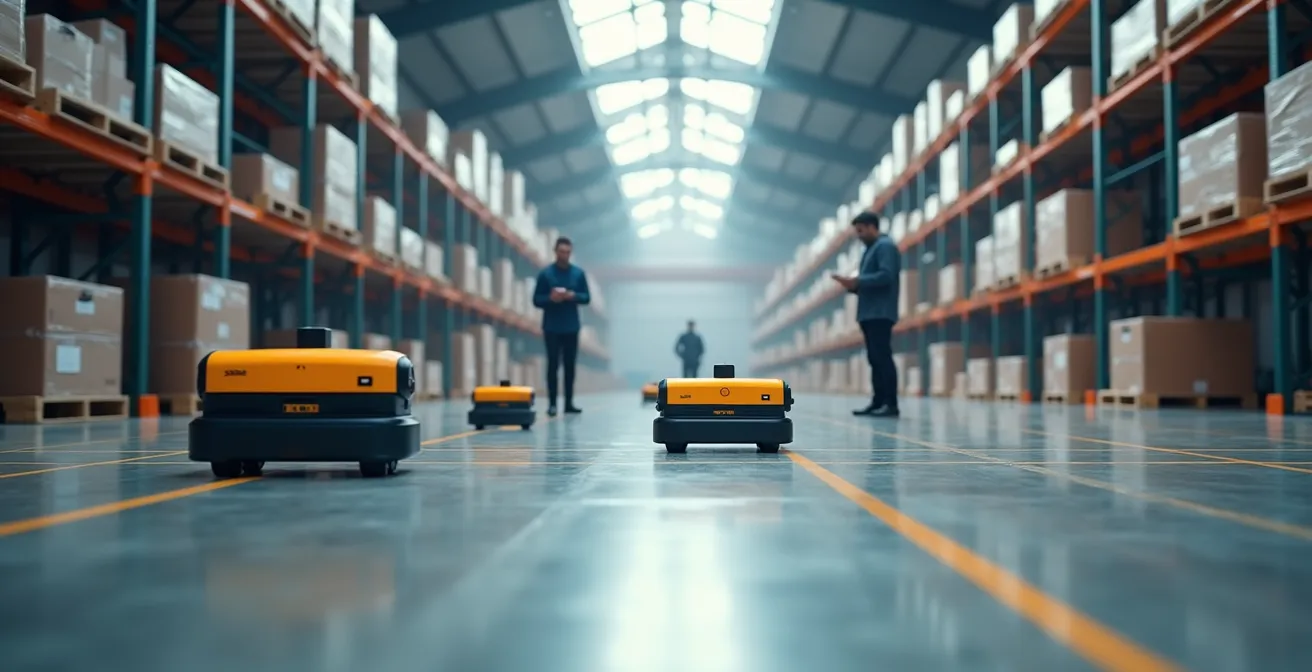
Robotic automation is the most pragmatic solution to the chronic labor shortage, not by replacing staff, but by augmenting your existing team to create a more resilient and efficient operation.
- Achieve faster ROI than traditional hiring in high-wage zones through massive productivity gains and reduced turnover costs.
- Integrate robots with your current WMS with near-zero downtime using modern middleware and digital twin simulations.
- Transform manual labor roles into safer, higher-value “robot wrangler” positions, boosting both morale and accuracy.
Recommendation: Shift your perspective from “hiring to fill gaps” to “automating to augment capacity” and start by identifying one repetitive, injury-prone task as your pilot project.
If you’re a warehouse director, the phrase “labor shortage” is more than a headline; it’s a daily operational headache. The constant cycle of recruiting, training, and then losing staff creates instability that ripples through the entire supply chain. A recent FreightWaves survey highlights this crisis, noting that approximately 73% of warehouse operators report difficulties in finding enough labor to meet their needs. The traditional solution—endless hiring cycles and paying escalating wages—is becoming an unsustainable game of catch-up. Many see automation as a drastic, expensive overhaul that will replace their entire workforce.
But what if this view is fundamentally flawed? The most effective approach isn’t about replacing people, but about strategically augmenting them. The core of the issue isn’t a simple lack of bodies; it’s the inefficient deployment of human skill on tasks that are repetitive, physically demanding, and prone to error. This is where the true power of robotic automation lies. By reassigning these tasks to machines, you don’t just fill a gap; you create operational resilience and elevate your existing human workforce into supervisory roles, managing a fleet of tireless, precise collaborators.
This article moves beyond the generic “automation is efficient” platitude. We will dissect the practical, strategic application of robotics as a workforce augmentation tool. We’ll explore the real ROI compared to hiring, demystify the integration process, highlight the critical maintenance strategies that prevent failure, and demonstrate how human-robot collaboration builds a safer, more accurate, and ultimately more scalable warehouse operation. This is your pragmatic guide to solving the labor crisis not by replacing your team, but by empowering it.
To provide a clear and actionable path, this guide is structured to address the key concerns and opportunities for warehouse directors. The following sections will walk you through the financial, technical, and operational realities of implementing a successful robotics strategy.
Summary: How Robotic Automation Strategically Solves Staffing Crises
- Why the ROI of Robotics Is Faster Than Hiring in High-Wage Zones?
- How to Integrate Robots With Your Existing WMS Without Downtime?
- The Maintenance Mistake That Turns Robots Into Expensive Paperweights
- Human-Robot Collaboration: Problem & Solution for Warehouse Safety
- Automated Picking: A Sequence to Reach 99.9% Accuracy
- Manual QC vs. Automated Vision Systems: The Solution for Zero Defects
- Cross-Docking Strategies: Problem & Solution for Reducing Storage Time
- How to Scale Manufacturing Outputs Without Sacrificing Quality Standards?
Why the ROI of Robotics Is Faster Than Hiring in High-Wage Zones?
The primary objection to automation is often the upfront capital expenditure. However, in high-wage markets plagued by chronic turnover, the financial equation has flipped. The “Total Cost of Vacancy”—encompassing recruitment fees, overtime for remaining staff, training costs for new hires, and lost productivity—is a silent killer of profitability. Robotic automation attacks these hidden costs directly, creating a faster return on investment than many directors realize. It’s not just about wage savings; it’s about creating predictable, consistent operational capacity.
The investment velocity of robotics is driven by radical productivity gains. While a human picker might handle 60-80 items per hour, a goods-to-person (GTP) system empowers that same worker to handle 200-300. This isn’t a marginal improvement; it’s a fundamental transformation of output per employee. This effect is compounded over time, as warehouse automation has the potential to reduce labor costs by 30-40% over a five-year period. This creates a stable cost base immune to labor market fluctuations.
Furthermore, this isn’t just theoretical. Real-world applications demonstrate the powerful business case for augmentation over simple hiring, especially when facing inefficiency.
Case Study: S&S Activewear’s Leap in Fulfillment Productivity
Facing inefficient labor allocation across its vast apparel distribution network, S&S Activewear partnered with Geekplus to deploy an end-to-end PopPick Goods-to-Person system. The goal was to optimize fulfillment, a challenge made more difficult by labor constraints. The results were staggering: in a pilot at one of Walmart’s first robotic warehouses, picking productivity for a single worker jumped from 149 to 533 pieces per hour. This massive increase in individual output demonstrates how automation directly augments a workforce to solve productivity bottlenecks, generating immediate and substantial ROI.
This leap in efficiency means the payback period for robotics is often measured in months, not years. When you compare the one-time cost of a robot to the recurring, ever-increasing annual cost of a human employee (including salary, benefits, and turnover expenses), the robotic investment proves to be the more financially sound, long-term strategy for building operational resilience.
How to Integrate Robots With Your Existing WMS Without Downtime?
The fear of a long, disruptive implementation that grinds operations to a halt is a major deterrent for many warehouse directors. The concern that a new robotics system will require a complete overhaul of a trusted, functional Warehouse Management System (WMS) is valid, but largely based on outdated integration models. Modern approaches prioritize seamless, non-disruptive integration, ensuring your facility remains productive from day one.
The key is moving away from brittle, direct-to-WMS custom coding. Instead, the industry standard is now a middleware layer, often called a Robotics Execution System (RES). This software acts as a universal translator between your WMS and a diverse fleet of robots (including both AGVs and more flexible AMRs). Rather than building a single, rigid connection, the RES provides a flexible hub, allowing you to add, remove, or upgrade different robotic systems without touching your core WMS logic. This “plug-and-play” capability is crucial for future-proofing your investment.
To eliminate downtime risk, forward-thinking integrators use digital twin simulation. Before a single physical robot touches your floor, they create a complete virtual replica of your warehouse. This allows them to test every process, workflow, and exception scenario in a simulated environment, stress-testing the integration between the WMS, the RES, and the robots. This ensures all bugs and bottlenecks are ironed out digitally, so that the physical go-live is smooth and predictable.

This split-screen view perfectly illustrates the concept: on one side, the virtual warehouse where integration is perfected; on the other, the physical reality where deployment happens flawlessly. This methodology is central to de-risking the entire project. For a pragmatic comparison of integration approaches, the following table breaks down the differences between old and new methods.
This table, based on an analysis of warehouse robotics integration, clearly shows the strategic advantage of a middleware approach for any director concerned with flexibility and uptime.
| Aspect | Direct WMS Integration | Middleware Layer (RES) |
|---|---|---|
| Setup Time | 3-6 months | 1-2 months |
| Flexibility | Limited to single robot brand | Multi-vendor support |
| Downtime Risk | High during implementation | Near-zero with sandbox testing |
| Future Scalability | Requires major changes | Plug-and-play additions |
| Cost | Lower initial, higher long-term | Higher TCO |
The Maintenance Mistake That Turns Robots Into Expensive Paperweights
The business case for robotics is compelling, but the investment is significant, with some analyses showing that robot costs typically range from $25,000 to $140,000 per system. The single biggest mistake a director can make after this investment is assuming the robots are a “set it and forget it” solution. Without a proactive maintenance and operations strategy, these advanced machines can quickly become the most expensive paperweights in your facility. The very labor crisis that automation is meant to solve can be exacerbated by robotic downtime.
The core problem is a failure to shift from a traditional maintenance mindset to a robotics-first operations model. This is especially critical in environments with high staff churn, which puts immense pressure on remaining systems and personnel. As one report on the labor shortage grimly notes:
The company dealt with average turnover of 100% of its team every six months.
– Warehouse Automation Report, How Robots Positively Impact the Labor Shortage
This level of turnover is a symptom of a broken operational model. Simply adding robots without changing the support structure is a recipe for disaster. The solution is to build a dedicated Robotics Operations team. This doesn’t mean hiring an army of expensive engineers. It starts with reskilling your existing, reliable staff. Your best warehouse associates can be trained to become “robot wranglers”—first-line responders who can handle 80% of common issues like clearing jams, rebooting units, and managing traffic flow. This creates a valuable new career path and ensures your expert engineers are only called for the most complex problems.
A robust maintenance strategy is proactive, not reactive. It leverages the data generated by the robots themselves to predict failures before they happen. By tracking metrics like battery health, motor temperature, and sensor errors, you can schedule predictive maintenance instead of suffering catastrophic, unplanned downtime during peak hours. The following checklist outlines the essential components of a maintenance strategy designed for maximum uptime.
Your Action Plan: Building a Resilient Robot Maintenance Strategy
- Build a Robotics Operations team with mechatronics and software skills.
- Implement predictive maintenance using robot-generated data analytics.
- Maintain a strategic spare parts inventory based on Mean Time Between Failure (MTBF) data.
- Negotiate strict Service Level Agreements (SLAs) with vendors for response times and first-time fix rates.
- Train existing staff as ‘robot wranglers’ for first-level exception handling.
- Schedule regular firmware and software updates during planned, low-traffic downtime windows.
Human-Robot Collaboration: Problem & Solution for Warehouse Safety
A common misconception is that introducing robots into a human-centric environment inevitably creates new safety hazards. While a poorly planned deployment can lead to collisions and accidents, a well-designed collaborative automation system actually makes the warehouse a significantly safer place to work. The problem isn’t the robots themselves, but the failure to clearly delineate and manage the spaces where humans and machines interact. The solution lies in smart zoning and leveraging technology to augment human safety, not compromise it.
The most significant safety benefit comes from reassigning the most physically damaging tasks to robots. This includes heavy lifting, repetitive bending, and walking miles on concrete floors each day. By having robots handle these strenuous activities, you drastically reduce the risk of musculoskeletal injuries, which are among the most common and costly workplace incidents in warehousing. In fact, data shows that warehouses with automation have seen a 25% reduction in workplace injuries. This isn’t just a number; it represents a tangible improvement in the well-being of your staff.
This is the essence of workforce augmentation: freeing humans from dangerous, low-value work to focus on tasks requiring judgment and dexterity. For example, Amazon’s Vulcan robot, equipped with a sense of touch, can stow items in hard-to-reach places, a task previously reserved for humans that could involve awkward reaching. This innovation doesn’t eliminate a job; it eliminates a source of potential injury, allowing that employee to manage a fleet of robots or handle complex quality control checks.
Effective human-robot collaboration relies on a clear system of zones. This often involves color-coded pathways: green zones for human-only foot traffic, blue zones for robot-only travel, and yellow zones for controlled, collaborative work. In these shared spaces, robots are equipped with advanced LiDAR and 3D cameras that allow them to detect a human’s presence, slow down, and navigate safely around them. This creates a predictable and secure environment where your team feels confident working alongside their robotic counterparts, knowing their safety is the system’s top priority.
Automated Picking: A Sequence to Reach 99.9% Accuracy
Inaccurate picks are a cancer in any fulfillment operation. They lead to costly returns, customer dissatisfaction, and wasted labor in rework. While a skilled human picker can achieve an accuracy rate of 95-97%, that remaining 3-5% error rate represents thousands of defects and significant financial loss in a high-volume facility. The problem is human fallibility, especially during long shifts. The solution is an automated picking sequence that systematically eliminates opportunities for error, pushing accuracy to 99.9% and beyond.
The sequence begins with a Goods-to-Person (GTP) system. Instead of having workers wander aisles searching for items, AMRs bring the correct storage totes directly to a stationary picking station. This single change eliminates the majority of picking errors caused by selecting from the wrong bin or location. The WMS directs the robot, and the worker’s task is simplified to picking from the single tote presented to them, with light-directed systems often pointing to the exact item required.
The next step in the sequence is automated verification. As the worker picks the item, it passes under a scanner that instantly confirms its barcode against the order. This provides immediate feedback, catching any potential error before the item is even placed in the outbound container. For more advanced applications, especially those dealing with items that are difficult to scan or handle, AI-driven vision systems take over. These systems can identify products by shape, size, and color, with some modern systems claiming 99.5% grasp accuracy even on challenging items like polybags or deformable packages.
The final element is the robotic arm, or “cobot,” working at the picking station. After the item is verified, a cobot can perform the final pick and place into the shipping tote. This removes the last variable of human error and increases throughput. This combination—GTP for delivery, scanners and vision for verification, and cobots for placement—creates a closed-loop system where every step is validated. It transforms picking from a manual, error-prone task into a precise, repeatable, and nearly flawless automated process.
Manual QC vs. Automated Vision Systems: The Solution for Zero Defects
The pursuit of zero defects is the holy grail of quality control. Traditional manual QC, while necessary, is a significant bottleneck. It’s slow, subjective, and prone to the same fatigue-driven errors as manual picking. A human inspector can only check so many units per hour, and their judgment can vary. The problem is that scaling output often means either hiring more QC inspectors or accepting a lower quality standard. Automated vision systems offer a third, superior option: the ability to scale output while simultaneously increasing quality.
The solution isn’t to eliminate human inspectors entirely, but to implement a hybrid QC system. Automated vision systems, powered by AI, are deployed to handle high-volume, repetitive checks. A camera mounted over a conveyor can inspect hundreds of items per minute for defects like incorrect labels, damaged packaging, or missing components. These systems are tireless and objective, applying the exact same criteria to every single item, 24/7. They don’t just spot defects; they generate real-time data that can be used to trace the root cause of quality issues back to a specific machine or process upstream.
This frees up your skilled human inspectors to focus on what they do best: complex, subjective assessments. Tasks that require judging color gradients, feeling for texture, or assessing a complex assembly are still best handled by human experts. The vision system acts as a high-volume filter, flagging only the questionable items for human review. This leverages the strengths of both machine and human, creating a QC process that is both incredibly fast and deeply intelligent.
The technology is evolving rapidly. For instance, the Kinisi Robotics KR1, an autonomous humanoid robot, is designed for precise pick-and-place tasks that can be applied to quality assurance, matching human dexterity for handling delicate or complex objects during inspection. This type of technology allows for automated handling and inspection in a single fluid motion, further accelerating the QC process. By combining high-speed vision systems with dextrous robots, warehouses can move closer than ever to the goal of zero defects without compromising on throughput.
Cross-Docking Strategies: Problem & Solution for Reducing Storage Time
In today’s fast-moving supply chains, storage is a liability. Every hour an item spends sitting on a shelf is an hour it’s not generating revenue. Cross-docking—the practice of moving goods directly from inbound to outbound trailers with minimal storage time—is the ideal, but it’s notoriously difficult to execute. The problem is synchronization. A slight delay in unloading an inbound truck or sorting goods can cause a catastrophic bottleneck, forcing everything into temporary storage and defeating the entire purpose. The solution lies in using robotic automation to accelerate and synchronize the inbound and outbound processes.
Automation’s first impact is at the receiving dock. Unloading trailers is back-breaking, time-consuming work. Innovations like the systems from Pickle Robot Company use one-armed robots to autonomously unload trailers, picking up boxes and placing them directly onto conveyor belts. These robots use a combination of AI and machine learning to handle varied box sizes and placements from day one. This dramatically speeds up the unloading process, making the inbound flow predictable and consistent—a critical first step for successful cross-docking.
Once off the truck, AMRs take over. Instead of using forklifts or pallet jacks to move goods to a temporary storage location, AMRs can immediately sort and transport items to the correct outbound dock. The RES (Robotics Execution System) coordinates this “dance,” ensuring that goods from an inbound trailer destined for multiple outbound locations are routed efficiently and in real-time. There is no “putaway” step; the warehouse floor becomes a fluid transit hub, not a static storage facility.
This robotic orchestration allows for more advanced cross-docking strategies, like “opportunistic cross-docking.” The WMS and RES can identify in real-time that an incoming product is needed to fulfill a new, high-priority order that just dropped. The system can then automatically reroute that specific item directly to a packing station and then to the outbound dock, bypassing even the pre-planned cross-docking path. This level of agility is impossible to achieve with manual processes but is standard for a fully integrated, robot-augmented warehouse.
Key Takeaways
- The labor crisis is a problem of workforce deployment, not just numbers; automation is a tool for augmentation, not replacement.
- True ROI comes from reducing hidden costs like employee turnover, rework, and injuries, making the payback period surprisingly short.
- A proactive maintenance strategy, centered on training existing staff as “robot wranglers,” is non-negotiable for ensuring uptime and protecting your investment.
How to Scale Manufacturing Outputs Without Sacrificing Quality Standards?
For any warehouse director, the ultimate goal is growth. But scaling output often comes at a price: quality standards slip, safety incidents rise, and the very operational stability you’ve built begins to crack under the strain. The traditional method of scaling—hiring more people and buying more space—is linear and fraught with diminishing returns. The problem is that manual processes don’t scale efficiently. The solution is to build a scalable foundation using modular automation and real-time data, allowing you to increase output exponentially without compromising quality.
This begins with thinking of your warehouse not as a single entity, but as a series of modular automation zones. Each zone (e.g., receiving, picking, packing, QC) can be scaled independently. If you need more picking capacity, you can add more AMRs to the picking zone without disrupting the packing or receiving operations. This modularity, orchestrated by a flexible RES, allows for targeted, incremental scaling that is far less risky and capital-intensive than building an entirely new facility.
Furthermore, a robot-augmented workforce provides the data needed for intelligent scaling. Every action taken by a robot is a data point. By analyzing this real-time throughput data, you can identify emerging bottlenecks before they become critical. If the data shows that items are piling up waiting for the packing station, you know precisely where to invest in your next automation module. This data-driven approach removes the guesswork from capacity planning, a stark contrast to the challenges of predicting the performance of a large, newly hired manual team.
Ultimately, this model of workforce augmentation is the key to sustainable growth. As you scale, your robots handle the increased volume of repetitive tasks, while your human team scales their supervisory capacity. A single “robot wrangler” who managed 20 robots can manage 40. A QC expert who reviewed exceptions from 5 vision systems can review exceptions from 10. You are scaling your team’s intelligence and oversight, not just their manual labor. This creates a resilient, high-quality operation that can grow with demand, finally breaking the exhausting cycle of the labor shortage.
The next logical step is to move from concept to action by analyzing your specific operational bottlenecks. Identifying the most repetitive, injury-prone, or error-ridden task in your facility is the perfect starting point for a high-impact pilot project that will demonstrate the true value of workforce augmentation.