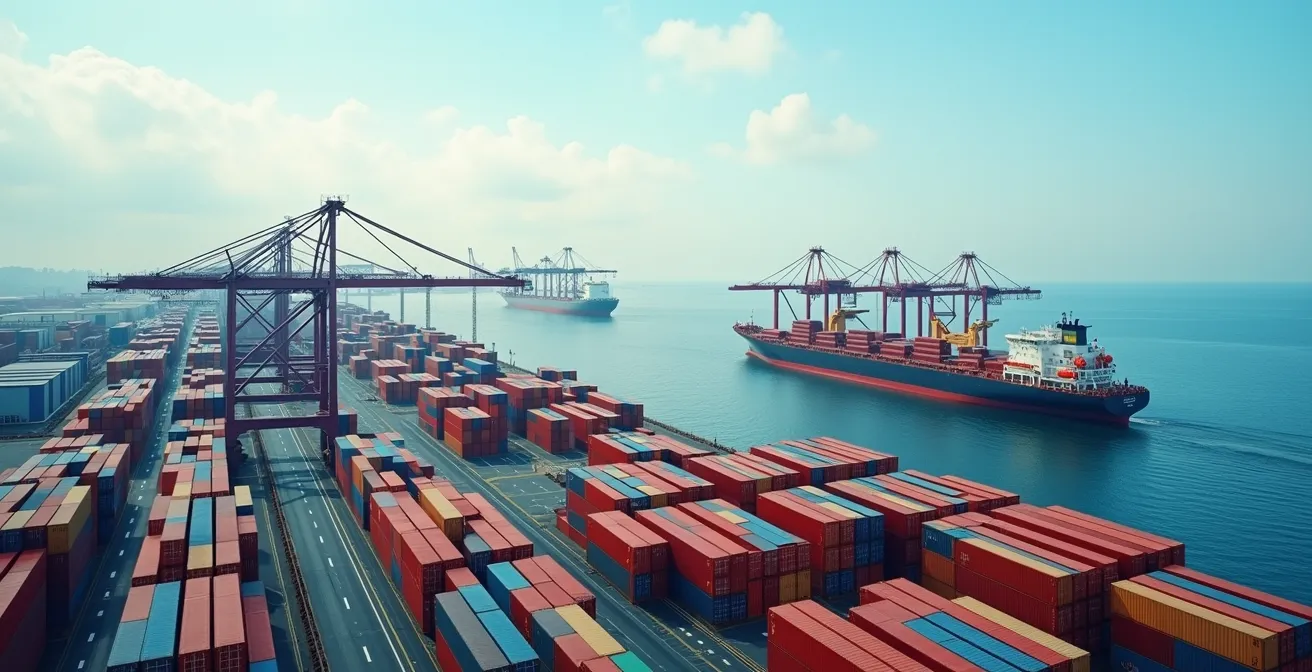
The true risk of a national trade deficit lies not in the headline number, but in the political and economic policy shifts it inevitably triggers.
- Chronic deficits create pressure for currency devaluation and the erection of protective trade barriers.
- A strategist’s advantage comes from forecasting these shifts by monitoring central bank actions, political rhetoric, and consumer sentiment.
Recommendation: Shift from a reactive to a predictive posture by building a framework that monitors leading indicators of policy change, not just lagging economic data.
For any business strategist involved in global trade, the monthly announcement of a nation’s trade balance is a familiar data point. A deficit, where imports exceed exports, is often met with a wave of generic analysis about economic weakness. The common advice is predictable: monitor exchange rates, beware of tariffs, and diversify your supply chain. While sound, this reactive posture leaves companies perpetually on the defensive, responding to policy changes after they have already been announced and the strategic advantage has been lost. It treats the symptoms, not the underlying political mechanics.
But what if the key wasn’t simply reacting to a deficit, but understanding it as a precursor to specific, predictable government actions? The real challenge for strategists is not acknowledging the risk, but forecasting its manifestation. A chronic trade deficit is a source of immense political pressure, pushing governments toward a limited menu of solutions, from sudden currency devaluations to populist “buy local” campaigns and targeted import restrictions. These are not random events; they are telegraphed by a series of economic and political ‘tells’ that can be identified and monitored.
This analysis moves beyond the platitudes of risk management. It provides a framework for interpreting the second-order effects of trade imbalances. We will deconstruct the signals that precede major policy shifts, examine the mechanics of protectionism, and outline a sequence for pivoting your sourcing and pricing strategy not just to survive, but to gain a competitive advantage in an environment of escalating economic nationalism. This is about transforming your import/export strategy from a responsive checklist into a predictive geopolitical tool.
Contents: How Trade Deficits Shape Your Strategic Landscape
- Why Countries With Chronic Deficits Are Prone to Sudden Devaluation?
- How to Spot Early Signs of Protective Import Restrictions?
- Export Incentives: Problem & Solution for Government Support
- The “Buy Local” Campaign Mistake That Underestimates National Sentiment
- reacting to Policy Shifts: A Sequence to Pivot Sourcing
- Why Protectionism Is Rising and How It Affects Your Bottom Line?
- The Pricing Mistake That Exposes You to Devaluation Risk
- How Trade Policies Impact Profit Margins for Cross-Border Sellers?
Why Countries With Chronic Deficits Are Prone to Sudden Devaluation?
A chronic trade deficit is fundamentally a statement of a nation’s financial imbalance: it spends more on foreign goods and services than it earns from its exports. To finance this gap, a country must attract foreign capital, effectively borrowing from the rest of the world. For a time, especially for nations with a reserve currency like the U.S. dollar, this is sustainable. For instance, in the United States, the goods and services deficit was 3.1 percent of current-dollar GDP in 2024, a gap financed by foreign investment in U.S. assets. However, for most countries, this dependency creates a significant vulnerability.
When foreign investor confidence wanes, or when the national debt becomes too large, the inflow of capital can slow or reverse. This forces the nation’s central bank to intervene, selling its foreign currency reserves (like U.S. dollars or Euros) to buy its own currency and prop up its value. This is a finite solution. As reserves dwindle, the country approaches a sovereign tipping point. The government is eventually forced to let the currency’s value fall—a devaluation. This makes imports more expensive, discouraging domestic consumption, and makes exports cheaper, boosting foreign demand. It’s a painful but often necessary rebalancing act.
For strategists, the key is to monitor the health of a nation’s foreign reserves. A pattern of steady decline is a major red flag. Key indicators that signal a breaking point include:
- Quarterly Reserve Sales Data: A consistent and accelerating drain on foreign reserves is the most direct signal. For example, reports of a country experiencing its largest quarterly reserve drain in years, such as the $48 billion in reserve sales seen in one U.S. Treasury report, indicate significant pressure.
- Months of Import Cover: This metric shows how many months of imports a country’s reserves can finance. When this number falls below the internationally recognized threshold of three months, alarm bells should ring.
- State-Directed Interventions: Watch for official announcements or subtle actions by the central bank to manage the exchange rate. An increase in the frequency or scale of these interventions signals distress.
How to Spot Early Signs of Protective Import Restrictions?
Long before formal tariffs are announced, a government considering protectionist measures will emit a series of political and administrative signals. These “economic tells” are invaluable for strategists looking to anticipate trade barriers rather than react to them. Protectionism rarely emerges from a vacuum; it is the culmination of domestic political pressure, lobbying from struggling industries, and a shift in national ideology. The transition from a policy of “free trade” to one of “fair trade” or “national security” is a critical linguistic marker. This change in rhetoric provides cover for implementing restrictive measures.
These measures often start not with broad tariffs, but with more subtle non-tariff barriers (NTBs). These can include new, complex technical standards, burdensome sanitary or phytosanitary (SPS) regulations, or stringent labeling and country-of-origin requirements. While ostensibly for consumer safety or information, they are designed to increase the cost and complexity for foreign firms, giving a competitive advantage to domestic producers. A sudden flurry of new regulatory proposals in a specific sector is a significant warning sign.

As the visual metaphor of a regulatory maze suggests, navigating these NTBs can be more challenging than simply paying a tariff. To stay ahead, strategists should monitor the following leading indicators:
- Increases in Anti-Dumping Complaints: A rise in domestic industries filing complaints against foreign competitors for “dumping” (selling goods below cost) is often a precursor to government action.
- Lobbying Activity: Tracking the lobbying expenditures and public statements of major industry associations can reveal which sectors are most aggressively pushing for protection.
- ‘Frontloading’ of Imports: When local businesses anticipate restrictions, they often “frontload” their imports to build inventory before the barriers are erected. Monitoring import data for unusual spikes in specific product categories can be a powerful predictive tool.
- Specific Government Actions: Real-world examples provide the clearest warnings. According to analysis, the EU applied duties of up to 45.3% on Chinese-made EVs while Mexico applied a 35% tariff on textiles, showing how targeted these measures can be.
Export Incentives: Problem & Solution for Government Support
While import restrictions are one way to address a trade deficit, the other side of the policy coin is boosting exports. Governments with chronic deficits often deploy a range of export incentive programs designed to make their domestic industries more competitive on the global stage. For a business strategist, understanding the nature, quality, and stability of these programs in a target country is critical. They can represent a significant opportunity for exporters, but also a hidden risk if they are politically volatile or poorly designed.
These support mechanisms are not created equal. High-quality, stable support often comes in the form of long-term structural programs. These include R&D tax credits to foster innovation, state-backed export credit insurance that mitigates payment risk for sellers, and the creation of special economic zones with favorable tax and regulatory regimes. These are generally reliable and integrated into a nation’s long-term industrial strategy. In contrast, low-quality support often takes the form of temporary cash grants or direct subsidies, which can be highly volatile and subject to abrupt withdrawal based on political whims or budget constraints.
A sophisticated approach for governments, and a key indicator for strategists to watch for, is the development of a modern industrial finance corporation. This entity can provide targeted, long-term funding to strategic sectors like advanced manufacturing or green technology, signaling a serious and stable commitment to export growth. The quality and stability of these various support types can be assessed as follows.
This table, based on an analysis of effective trade deficit reduction tools, helps evaluate the reliability of a country’s export support ecosystem.
| Support Type | Quality Level | Stability | Example |
|---|---|---|---|
| R&D Tax Credits | High | Long-term | Export credit guarantees, special economic zones, and export-promotion councils are all tools that countries like South Korea, Taiwan, and even China have used to stunning effect |
| Export Credit Insurance | High | Stable | State-backed guarantees |
| Temporary Cash Grants | Low | Volatile | Politically motivated subsidies |
| Industrial Finance Corp | Medium-High | Growing | A modern version of that strategy could come in the form of an industrial finance corporation. With targeted funding, this entity could support advanced manufacturing, green energy, and high-tech exports |
The “Buy Local” Campaign Mistake That Underestimates National Sentiment
Beyond formal policy, one of the most powerful tools governments can wield in response to a trade deficit is stoking national sentiment. “Buy Local” or “Made in America” campaigns are not just marketing slogans; they are instruments of informal protectionism. They aim to shift consumer preference away from foreign goods by appealing to patriotism, quality concerns, or fears of domestic job loss. Many foreign companies make the strategic error of ignoring these campaigns, viewing them as mere background noise. This dramatically underestimates their power to alter market dynamics and erode market share.
Case Study: The Power of Marketing Against Import Shocks
The “China Shock”—the surge of Chinese imports into the U.S. following its entry into the WTO—had a devastating impact on many American firms. Research from Texas A&M University analyzed the performance of over 800 publicly listed U.S. companies during this period. The study found a clear trend: firms with powerful marketing departments were significantly more resilient to this intense import competition. They were better able to protect their revenue and market value by reinforcing their brand identity, emphasizing quality, and strengthening customer loyalty, effectively creating a defensive moat against low-cost foreign alternatives.
For an import-focused business or a foreign brand entering such a market, competing on price alone is a losing strategy. The narrative has been shifted to one of value, identity, and local benefit. Instead of retreating, the correct strategic response is to co-opt or neutralize the “buy local” narrative. This requires a nuanced approach that goes beyond product features and focuses on the company’s local footprint and value contribution. A foreign product can succeed by reframing its identity within the local context.
This means highlighting aspects that resonate with the national sentiment. Does the product use world-leading technology unavailable locally? Frame it as a tool that empowers local industries. Does the company’s distribution and sales network create local jobs? Emphasize that economic contribution. Partnering with local firms for service and support can also build goodwill and a sense of local integration.
Your Action Plan: Thriving in a ‘Buy Local’ Environment
- Frame your product as ‘best-in-world’ technology or quality that local options cannot match, justifying its import.
- Educate customers on the total cost of ownership, highlighting superior durability, efficiency, or lower long-term costs versus cheaper local alternatives.
- Emphasize the local jobs your company creates through its logistics, sales, marketing, and service operations within the country.
- Partner with respected local firms for distribution, final assembly, or customer service to create a hybrid local identity.
- Offer customization and smaller order sizes that larger domestic competitors may be too inflexible to provide.
reacting to Policy Shifts: A Sequence to Pivot Sourcing
In an era of rising protectionism and currency volatility, the traditional model of a static, cost-optimized supply chain is a liability. Resilience requires a dynamic approach to sourcing—one that can pivot quickly in response to policy shifts. The key is not to react when a tariff is announced, but to have a pre-vetted plan ready to activate. This involves building a “shadow supply chain” with secondary and tertiary suppliers in different geopolitical and currency zones.
This strategy is about building redundancy and flexibility. It means maintaining “warm” relationships with backup suppliers, perhaps through small, regular orders, so that production can be scaled up quickly when needed. It also requires rigorous pre-qualification to ensure these alternative suppliers meet your quality, ethical, and logistical standards long before a crisis hits. The goal is to reduce the time from a policy decision to a sourcing pivot from months to weeks.

Contractual language is another critical layer of defense. Your agreements with primary suppliers should include specific clauses that trigger a re-evaluation or exit. A material adverse change (MAC) clause can be written to explicitly name tariff imposition or significant currency devaluation as a trigger event. Furthermore, building currency fluctuation clauses into contracts can help share the risk of adverse exchange rate movements, rather than having the importer bear the entire burden. This proactive, structured approach transforms sourcing from a cost center into a strategic risk management function.
A sequence for building this capability involves several key steps:
- Pre-qualify Secondary Suppliers: Identify and vet alternative suppliers in different currency zones, focusing on regions with different trade agreements or political postures.
- Maintain ‘Warm’ Relationships: Place small, consistent orders with backup suppliers to keep them engaged and ensure they are ready to ramp up production when called upon.
- Implement Smart Contracts: Build material adverse change clauses that name specific tariff triggers, and currency fluctuation formulas to manage financial risk.
- Model Total Landed Cost: Create and maintain total landed cost models for different sourcing scenarios. This allows for rapid analysis and decision-making when a policy shift occurs, enabling a data-driven pivot rather than a panicked reaction.
- Reduce Dependency Incrementally: Set strategic goals to shift a small percentage of sourcing, such as a plan to reduce dependency by 10% on a single region, to test and strengthen alternative supply routes before they are critically needed.
Why Protectionism Is Rising and How It Affects Your Bottom Line?
The global consensus in favor of free trade has fractured. Today, protectionism is on the rise, driven by a confluence of geopolitical competition, domestic political pressures, and a growing public sentiment that global trade has disproportionately benefited corporations over workers. For businesses engaged in cross-border commerce, this is not a theoretical political debate; it is a direct threat to the bottom line. Protectionist policies, primarily through tariffs and non-tariff barriers, introduce costs and frictions that ripple through the entire value chain.
The most immediate impact is on the cost of goods. A tariff is a tax on imports, and this cost must be either absorbed by the importer (compressing margins), passed on to the consumer (risking a drop in demand), or a combination of both. The effect on consumers can be substantial, reducing their disposable income and overall purchasing power. For example, one analysis of proposed tariffs in the U.S. estimated a potential average loss of $1,145 per household in disposable income.
Case Study: The EU’s Agricultural Fortress
The European Union’s Common Agricultural Policy (CAP) is a prime example of deeply entrenched protectionism. To shield its farmers from foreign competition, the EU employs a formidable arsenal of tariffs and subsidies. As detailed in economic analyses, these measures are highly effective barriers. For instance, import duties on foreign sugar can exceed 100%, while high tariffs on dairy and meat make it nearly impossible for many non-EU producers to compete on price in the European market. This strategy successfully protects a domestic industry but does so at the expense of consumer choice and higher prices.
The macroeconomic consequences extend beyond consumer prices. Widespread protectionism and retaliatory tariffs create a drag on global economic growth. The uncertainty alone can cause businesses to delay investment and hiring decisions, further slowing economic activity. The following table illustrates potential impacts on GDP and inflation under different tariff scenarios, highlighting the systemic risk involved.
| Scenario | 2025 GDP Impact | 2026 GDP Impact | Inflation Impact |
|---|---|---|---|
| 60% China Tariffs + 10% Others | -1.2 percentage points | -1.2 ppt | +1ppt by Q4 2025 |
| Global Retaliation | -0.5ppt globally | -0.9ppt globally | Varies by region |
| Current Tariffs (Status Quo) | -0.21% long-run | Stable | Minimal |
The Pricing Mistake That Exposes You to Devaluation Risk
For companies selling into or sourcing from countries with chronic trade deficits, one of the most common and dangerous mistakes lies in pricing strategy. Many businesses set their prices in the local currency based on production costs and a desired margin, then fail to adequately account for exchange rate volatility. When that country’s currency inevitably devalues, the value of your revenue or the cost of your inputs can change dramatically overnight, erasing profit margins.
The complexity is magnified by the dominant role of the U.S. dollar in global trade invoicing. Even when trading between two other countries, contracts are often priced in dollars. As one analysis highlights, the dominant role of the dollar in global trade invoicing limits the buffering from exchange rate adjustments. This means a strengthening dollar can make U.S. exports more expensive and imports cheaper, amplifying deficit issues and creating unpredictable pricing pressures for businesses operating in that ecosystem. Simply hoping the exchange rate remains stable is not a strategy; it’s a gamble.
A robust pricing framework must be currency-aware. The first step is to assess the price elasticity of your product. If you sell a unique, “must-have” product with low elasticity, you have more power to price in a stable currency (like USD or EUR) or to pass on currency-related cost increases to customers. If your product is a commodity with high elasticity, you have far less pricing power and must focus on hedging or other mitigation strategies. A critical mistake is treating all products the same, without regard to their market power.
Building a currency-adjusted pricing framework requires a deliberate decision process:
- Assess Price Elasticity: Determine how sensitive demand for your product is to price changes in each market. This dictates your ability to pass on costs.
- Compare Hedging vs. Contractual Adjustments: Evaluate the cost of financial instruments (like forward contracts) to hedge currency risk against the feasibility of building price adjustment clauses into your sales agreements.
- Anchor Prices to ROI: Instead of pricing based on your production cost, anchor your price to the tangible return on investment (ROI) or value your product delivers to the customer. This makes the price more defensible.
- Consider Multi-Currency Pricing: For sophisticated operations, offer pricing in different currencies for different market segments, allowing you to optimize revenue and risk across your portfolio.
- Anticipate Demand Shifts: Acknowledge that currency movements directly impact demand. As a CRS report notes, a higher dollar would reduce demand for U.S. exports, a principle that applies globally.
Key Takeaways
- Chronic trade deficits are not just economic data; they are leading indicators of future political action like devaluation and protectionism.
- Forecasting policy shifts requires monitoring “economic tells”: central bank reserve levels, shifts in political rhetoric, and spikes in anti-dumping complaints.
- Resilience is built on a dynamic sourcing strategy with pre-vetted alternative suppliers and currency-aware contractual clauses.
How Trade Policies Impact Profit Margins for Cross-Border Sellers?
Ultimately, every aspect of a nation’s trade policy—from currency fluctuations and tariffs to export incentives and “buy local” campaigns—converges on a single point for your business: profit margin. These policies introduce a complex web of direct and indirect costs that can systematically compress margins if not proactively managed. The impact goes far beyond the obvious cost of a tariff; it extends into operational, administrative, and strategic costs that are often overlooked.

Direct costs are the most visible. Tariffs increase the landed cost of goods. Currency devaluation increases the cost of imported inputs or decreases the value of foreign revenue. But the second-order effects are just as damaging. Trade friction increases supply chain complexity, leading to higher administrative (SG&A) costs for compliance, legal review, and logistics management. This was visible even in positive news, where a 10.9% deficit reduction in the US was the result of immense underlying friction. Uncertainty about future policy can force companies to hold more inventory (“safety stock”), tying up working capital and increasing carrying costs.
The strategic response to this margin pressure depends heavily on your product’s position in the market. The ability to pass on increased costs to customers without losing significant volume is a function of price elasticity. A commodity producer has almost no power to pass on tariff costs, whereas the maker of a unique, highly-differentiated product has considerable leverage. Understanding where your products fall on this spectrum is the foundation of a resilient pricing strategy in a protectionist world.
This framework from a Masterclass analysis on trade deficits provides a clear strategic guide for navigating tariff pass-through based on product type.
| Product Type | Price Elasticity | Tariff Pass-Through Ability | Strategy |
|---|---|---|---|
| Must-Have/Inelastic | Low | High (75-100%) | Pass costs to customers |
| Nice-to-Have/Elastic | High | Low (0-25%) | Absorb costs or exit market |
| Differentiated/Unique | Medium | Medium (25-75%) | Partial pass-through with value emphasis |
| Commodity | Very High | Near Zero | If a country imports more than it exports, unemployment may increase. For example, if a country shifts from manufacturing cars to importing cars from international car manufacturers, the job market for car manufacturing will be negatively impacted |
To maintain a competitive edge, the next step is to integrate this forecasting framework into your regular strategic planning and risk assessment cycles, turning geopolitical analysis into a tangible commercial advantage.